

Canadian enterprises are at an important crossroads. Across industries like healthcare, fintech, manufacturing, retail, and professional services, business leaders are actively exploring generative AI to improve productivity, enhance customer experience, support better decision-making, and streamline workflow efficiency.
However, generative AI adoption is not something to rush. It involves your data, your people, your systems, and your governance frameworks. When approached thoughtfully, it can become a meaningful part of your digital transformation journey.
Why Generative AI Adoption Matters for Canadian Enterprises
The pressure to do more with less is real. Teams are dealing with growing content workloads, slow internal knowledge retrieval, repetitive documentation tasks, and increasing customer support demands. Generative AI in enterprises addresses several of these pain points in practical ways.
AI solutions for Canadian enterprises can help with:
- Automating repetitive business processes so teams can focus on higher-value work
- Giving employees faster access to internal knowledge and documentation
- Supporting customer support teams with intelligent automation
- Improving content and document workflows across departments
- Accelerating digital transformation efforts without overhauling existing systems
Generative AI adoption in business is not about replacing teams. It is about giving your people better tools to work smarter and respond faster.
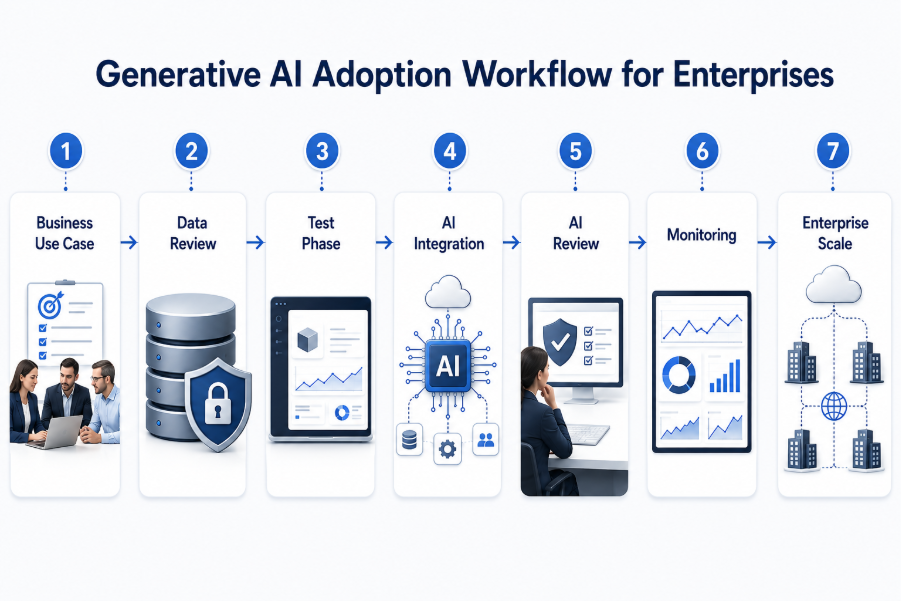
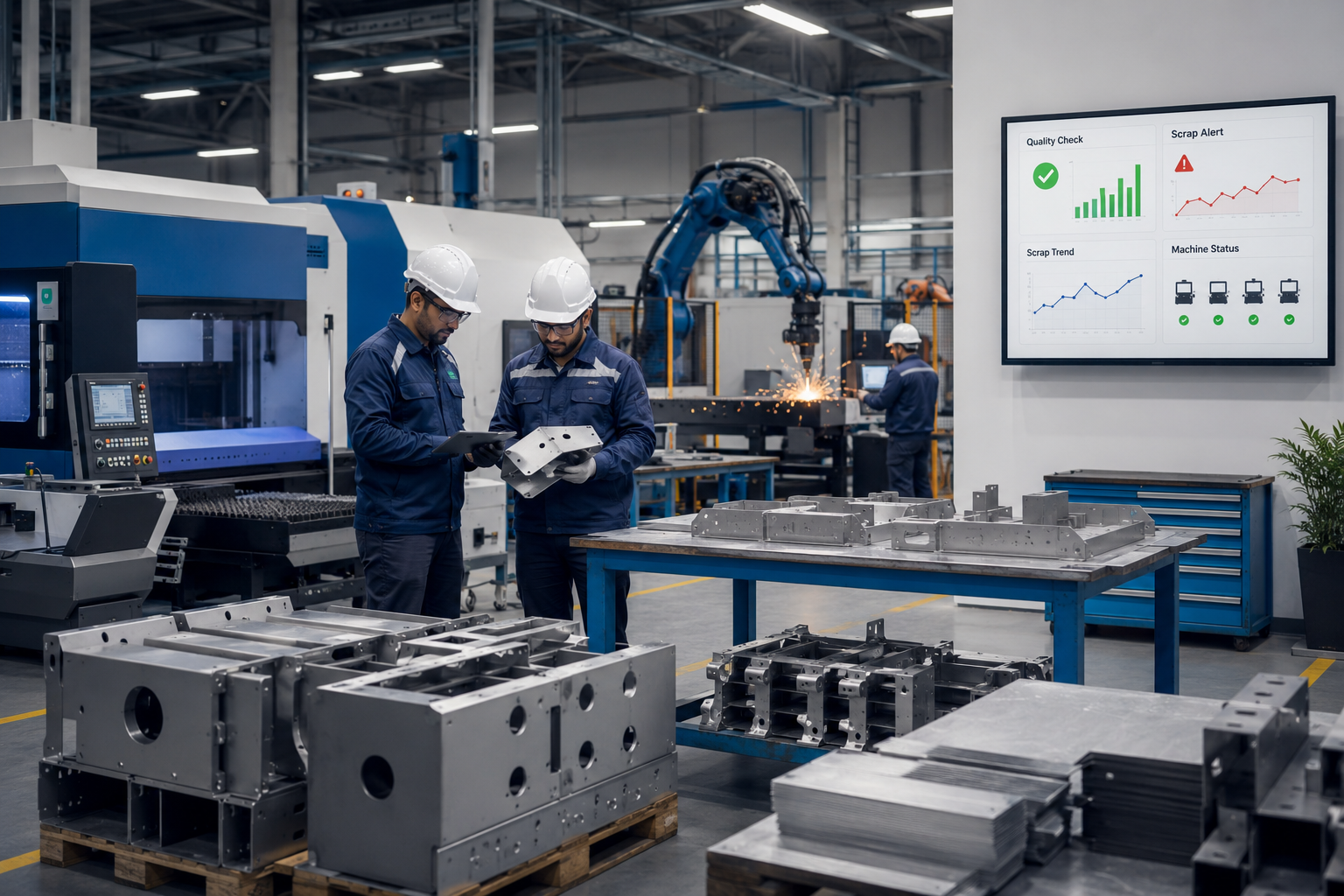
Figure: Generative AI adoption workflow for enterprises
Key Opportunities of Generative AI in Enterprises
Generative AI solutions in Canada are already being explored across a wide range of enterprise use cases. Here are some of the most practical opportunities:
- AI chatbots and virtual assistants for customer support: Handle common queries, reduce response times, and free up your support staff for complex issues.
- Internal enterprise knowledge search: Let employees find answers from large document libraries, policies, or past projects in seconds rather than hours.
- Automated report and document generation: Generate first drafts of reports, summaries, proposals, and internal memos with AI assistance.
- Personalized customer communication: Create tailored messages, follow-ups, and marketing content at scale.
- Sales and marketing content support: Speed up the creation of pitches, email campaigns, and social content.
- Software development assistance: Support development teams with code suggestions, documentation, and testing support.
- Employee training and onboarding: Build AI-powered training modules that adapt to employee roles and learning pace.
- Workflow automation for repetitive tasks: Reduce manual data entry, form processing, and routine approvals using AI-powered enterprise automation.
These use cases are already being explored by many enterprises, with the potential to improve team efficiency and operational consistency when implemented properly.
Main Challenges of Generative AI Adoption
A responsible AI strategy means understanding the challenges alongside the opportunities. Here are the key areas to plan for:
- Data privacy and security concerns: Generative AI requires access to data, which means your security protocols, access controls, and data handling practices must be carefully reviewed.
- Integration with existing enterprise systems: Most enterprises run on legacy platforms, ERPs, and CRMs. Connecting AI tools with these systems requires thoughtful planning.
- Inaccurate or incomplete AI outputs: AI models can produce outputs that need human review, especially for regulated or sensitive content.
- Employee adoption and training: Teams need guidance, training, and time to trust and effectively use new AI tools.
- Compliance and governance: Canadian enterprises must consider federal and provincial privacy regulations, including PIPEDA and sector-specific rules.
- Cost planning and scalability: AI infrastructure, licensing, and maintenance costs need to be factored into your digital investment plan.
- Need for human review and quality control: AI should support human decision-making, not replace it entirely. Human oversight remains important, especially for customer-facing or high-stakes outputs.
Acknowledging these challenges upfront makes for a much stronger implementation strategy.
Responsible Implementation Approach
Enterprise generative AI implementation works best when it follows a structured and phased approach. Instead of adopting AI across every process at once, enterprises should begin with clear priorities, secure data practices, and human oversight. This helps reduce risk while making the adoption process easier for teams to understand and manage.
A practical starting point includes:
- Identify clear business use cases: Focus on specific problems you want to solve, not AI for its own sake.
- Start with a small pilot project: Test your chosen use case in a controlled environment before scaling it across departments.
- Use secure data access and role-based permissions: Make sure only the right people have access to sensitive data used in AI workflows.
- Add human review for important outputs: Do not automate final decisions without a human checkpoint, especially for regulated industries.
- Integrate with existing tools and workflows: AI adoption works best when it fits into how your teams already work.
- Monitor performance and improve over time: Track accuracy, usage, and business impact regularly.
- Create internal AI usage guidelines: Give employees clear direction on how to use AI tools responsibly and effectively.
Business Benefits for Canadian Enterprises
When implemented properly, generative AI can support meaningful improvements across enterprise operations:
- Improved team productivity through reduced manual workload
- Faster response times for customer and internal requests
- Reduced time spent on repetitive and low-value tasks
- Better access to internal knowledge and institutional information
- More consistent customer communication across channels
- Faster document and report preparation for teams under time pressure
- Stronger support for enterprise AI transformation and long-term digital growth
These benefits are realistic when AI adoption is planned carefully, piloted responsibly, and expanded with proper oversight.
Why Choose Theta Technolabs
Theta Technolabs helps businesses design and develop AI-powered digital solutions that align with real business needs, not just technology trends.
Our team brings hands-on experience in building secure, scalable, and practical solutions for enterprise clients. Our capabilities include:
- Generative AI solution development: Custom generative AI development built around your specific business workflows and goals.
- AI chatbot and virtual assistant development: Intelligent conversational tools for customer support and internal use.
- Custom software development: Tailored applications designed for your operational requirements.
- Web application development: Scalable, modern web platforms that support enterprise workflows.
- Mobile application development: iOS and Android solutions for on-the-go enterprise needs.
- Cloud consulting and cloud-based platforms: Infrastructure planning and deployment on leading cloud platforms.
- Secure, scalable enterprise automation systems: End-to-end automation solutions with security and compliance built in.
We work alongside your team to ensure that every solution we build is practical, well-integrated, and ready for real enterprise use.
FAQs
1. What is generative AI adoption in enterprises?
Generative AI adoption in enterprises means using AI tools and models to support business tasks such as content creation, customer support, report generation, workflow automation, knowledge search, and decision support.
2. How can enterprises use generative AI?
Enterprises can use generative AI for AI chatbots, document automation, internal knowledge search, customer communication, software development support, employee training, and business process automation.
3. What are the main challenges of generative AI adoption?
Common challenges include data privacy, security, integration with existing systems, inaccurate outputs, employee adoption, model governance, and cost planning.
4. Is generative AI safe for enterprise use?
Generative AI can be safe for enterprise use when businesses apply proper data security, access control, human review, compliance checks, and responsible AI governance.
5. How does Theta Technolabs help with generative AI solutions?
Theta Technolabs helps businesses design and develop generative AI solutions, AI chatbots, enterprise automation tools, web applications, mobile applications, and cloud-based platforms.
Conclusion
Generative AI can help Canadian enterprises improve productivity, automate workflows, enhance customer support, and support digital transformation when implemented responsibly. The key is to start with a clear business case, build with proper governance, and scale with confidence.
If your enterprise is exploring what AI can do for your operations, partnering with an experienced generative AI development company can make the difference between a well-structured implementation and one that stalls before delivering value.
Ready to Build Your AI-Powered Enterprise Solution?
Theta Technolabs helps Canadian businesses build scalable AI, Web, Mobile, and Cloud solutions for enterprise automation and digital transformation.
Whether you are exploring your first AI use case or ready to expand an existing implementation, our team is here to help you plan, build, and grow with confidence.
Connect with us at sales@thetatechnolabs.com to discuss your generative AI project.