

Introduction
Fintech apps carry significant responsibility. They handle user identity, payment data, banking records, lending information, digital wallets, and financial transactions that directly affect people's money and personal information. This makes them very different from standard software products.
Building regulatory-compliant fintech apps in Canada means more than writing clean code or designing a smooth user experience. It means embedding security, privacy, and accountability into the product from day one. Understanding how Canadian fintech companies build compliant apps starts with accepting that compliance is not a finishing layer. It is a core structural requirement.
If your product will interact with sensitive financial data under Canadian regulations, getting the architecture right from the start saves time, money, and credibility later.
Why Compliance Matters in Canadian Fintech Apps
Fintech apps collect and process sensitive information, including government-issued IDs, bank account details, credit history, and transaction records. When this data is not handled carefully, the consequences extend well beyond technical failures.
Fintech compliance in Canada is a business priority, not just a regulatory requirement. Banks and financial institutions need to trust your platform before they will partner with you. Investors want to see that risk is managed responsibly. Customers want confidence that their financial information is protected.
Compliance also supports operational continuity. A platform built with strong identity verification, data protection, and monitoring practices is more resilient and better positioned for long-term growth.
Main Compliance Areas Fintech Companies Should Consider
Fintech companies in Canada should plan around several key compliance areas during product development.
Data Privacy and Consent: Users must be clearly informed about how their data is collected, stored, and used. Consent should be recorded and users should have options to manage their preferences.
KYC and Identity Verification: Know Your Customer processes help confirm that users are who they claim to be, which is essential for fraud prevention.
AML Monitoring: Anti-money laundering practices require platforms to monitor transactions for suspicious patterns and report unusual activity through appropriate channels.
Secure Payments: Payment flows must be protected through encryption, tokenization, and secure gateway integrations.
Audit Logs: All major user actions and system events should be logged with timestamps for accountability and review.
Access Control: Only authorized personnel should access sensitive systems and user data. Role-based permissions reduce internal risk.
Risk Monitoring: Continuous monitoring helps platforms identify suspicious behaviour and respond before issues escalate.
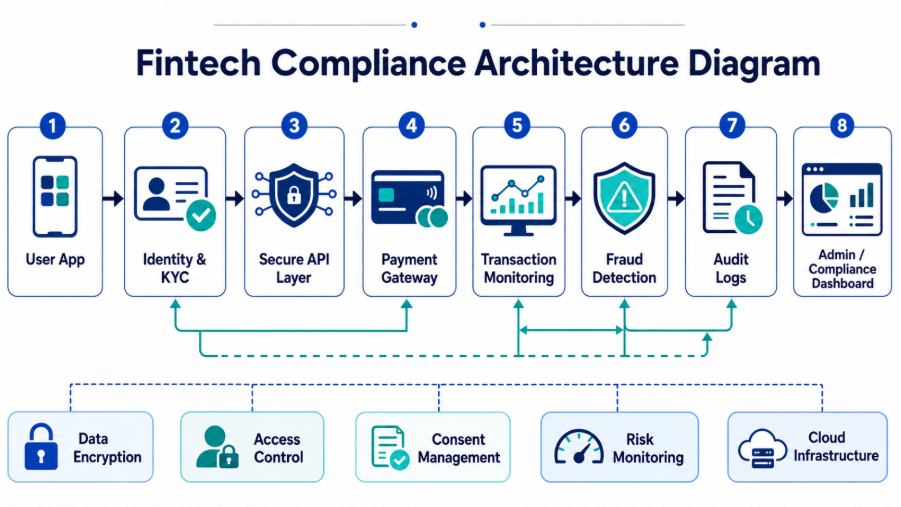
Figure: Fintech compliance architecture showing how user access, identity verification, secure APIs, payment systems, transaction monitoring, fraud detection, audit logs, and compliance dashboards work together in a fintech app.
Fintech companies should work with legal, compliance, and technology experts to align their app with applicable Canadian regulations.
Features Required in a Regulatory-Compliant Fintech App
Secure fintech app development is not only about what the app does for users. It is also about what the app does to protect users, their data, and the financial system around them.
Key features that support safer and more compliant fintech apps include:
- Multi-factor authentication to verify identity at login
- KYC verification with document uploads and identity checks
- Data encryption for information at rest and in transit
- Role-based access control for internal teams and admins
- Fraud detection alerts triggered by unusual activity
- Transaction monitoring across payment flows
- Secure API integration with banks and payment gateways
- User consent management with clear opt-in and opt-out controls
- Audit trail logs capturing all key platform actions
- Admin dashboard for compliance teams to review and act on alerts
- Risk monitoring tools that flag anomalies in real time
Each feature serves a specific purpose in keeping the platform accountable.
How Canadian Fintech Companies Build Compliance from the Start
Compliance should never be added at the end of development. It needs to be planned from the earliest stage of product design.
Canadian fintech app development done well starts with a clear understanding of the business model and what financial data the platform will handle. This means identifying what data will be collected, stored, and shared before anything else is built. Security and compliance requirements should be defined before design begins, not after. User flows need to be designed with privacy in mind, and APIs must be built to protect data throughout every interaction.
From there, KYC, AML, and fraud monitoring should be integrated into the core architecture rather than bolted on later. Before launch, thorough security and functional testing helps catch gaps early. After launch, ongoing monitoring and incident response systems keep the platform secure as it grows.
When compliance is a foundational requirement, it is easier to maintain and reduces the need for costly redesigns later. Because requirements can vary by business model, fintech companies should confirm legal and regulatory obligations with qualified compliance professionals before launch.
Role of Cloud Infrastructure in Fintech Compliance
Cloud infrastructure plays a direct role in how fintech apps manage data security, availability, and compliance readiness.
A well-configured cloud environment supports fintech platforms through:
- Secure hosting with network isolation and access controls
- Encryption for data stored in databases and backups
- Automated backup and disaster recovery planning
- Detailed access logs and real-time monitoring dashboards
- Scalable infrastructure that grows with your user base
- Compliance-ready deployment configurations
Businesses that need expert guidance often partner with providers offering cloud solutions consulting services in Canada to design infrastructure that supports both performance and regulatory requirements.
Getting cloud infrastructure right reduces risk, improves uptime, and gives compliance teams the visibility they need.
Technology Stack for Compliant Fintech Apps
Building secure and compliant fintech applications in Canada requires a technology stack that supports functionality, security controls, and scalability together.
A practical stack includes:
- Frontend: React, Angular, or Vue for responsive and accessible user interfaces
- Backend: Node.js, Python, Java, or .NET for reliable server-side systems
- Database: PostgreSQL, MongoDB, or MySQL with encryption and access controls
- Cloud: AWS, Azure, or Google Cloud with compliance and security configurations
- Security: Data encryption, multi-factor authentication, tokenization, and API gateway protection
- AI and ML: Fraud detection models, risk scoring systems, and suspicious activity monitoring
The right combination depends on your business model, transaction volume, and specific compliance requirements.
Simple Use Case Example
Consider a Canadian digital wallet app built for everyday payments. To operate safely, it would typically need:
- User registration with email and phone verification
- KYC verification using government ID and identity matching
- Bank account linking through secure open banking APIs
- Encrypted payment processing with tokenization
- Real-time transaction monitoring with automated fraud alerts
- An admin dashboard for reviewing flagged activity
- Audit logs capturing every user action and system event
- User consent records tied to each account
Each element serves both a user need and a regulatory purpose.
Business Benefits of Regulatory-Compliant Fintech Apps
Investing in regulatory-compliant fintech apps in Canada can support business value beyond meeting basic expectations.
Benefits include:
- Customer trust: Users engage more confidently with platforms that protect their data
- Safer transactions: Security features reduce fraud exposure for both users and the business
- Fewer operational risks: Compliance practices lower the chances of costly disruptions
- Investor confidence: A well-structured, compliant product is more attractive to investors
- Banking partnerships: Financial institutions prefer platforms that take compliance seriously
- Stronger reputation: A secure and reliable app builds lasting brand value
- Better fraud prevention: Real-time monitoring reduces financial losses
- Scalability: Compliance-ready architecture supports growth without major rework
When compliance is treated as a product feature, it becomes a genuine competitive advantage.
Conclusion
Building a fintech app in Canada requires more than launching a product with the right features. It demands secure architecture, privacy-focused design, identity verification, transaction monitoring, fraud detection, risk controls, and audit-ready systems working together from the start.
Theta Technolabs supports fintech businesses with capabilities across fintech product architecture, secure payment workflows, API integrations, KYC and AML-ready modules, fraud monitoring systems, scalable cloud infrastructure, and data protection practices.
If you are planning to build or strengthen a fintech product, Theta Technolabs can support your team with secure architecture, payment workflow development, KYC and AML-ready modules, API integrations, fraud monitoring systems, and scalable fintech infrastructure. For businesses searching for a fintech app development company in Canada, the right partner should understand both technology execution and compliance-focused product planning.
Work With Theta Technolabs
Theta Technolabs works with fintech businesses on secure application development, digital wallet and payment platform development, KYC and AML workflow integration, fraud detection module development, API integration, and cloud-based fintech infrastructure.
If you are ready to build a fintech product that is secure, scalable, and designed with compliance in mind, reach out to the team at sales@thetatechnolabs.com.