Patient intake is necessary, but it often takes up a lot of staff time. Clinics, hospitals, telehealth providers, and digital health companies must collect patient details, appointment reasons, medical history, insurance information, and consent before the consultation even begins.
A HIPAA-compliant chatbot for patient intake can make this first step easier by collecting required details before the appointment. It can reduce manual form handling, help staff prepare clearer patient information, and improve the intake experience for patients. For Canadian healthcare organizations, HIPAA-style safeguards are useful, but local privacy rules and careful data handling matter too.
What Is a HIPAA-Compliant Patient Intake Chatbot?
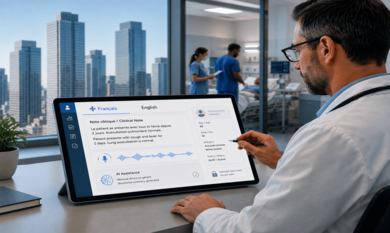
A patient intake chatbot is a digital assistant that helps patients share required information before a medical appointment. It can be added to a healthcare website, mobile app, patient portal, SMS link, or telehealth platform.
Depending on the workflow, consent process, and privacy requirements, the chatbot may collect details such as:
- Patient name and contact details
- Appointment reason
- Symptoms or health concerns
- Medical history
- Medication and allergy information
- Insurance or billing details
- Consent confirmation
- Preferred communication method
The term “HIPAA-compliant” is often used because HIPAA is widely recognized in healthcare technology. However, for a healthcare chatbot in Canada, providers should also consider Canadian privacy laws, provincial healthcare privacy requirements, consent rules, data storage practices, and secure access controls.
The chatbot’s role is to support intake, not act as a doctor, or replace clinical judgment.
How Patient Intake Chatbots Work Step by Step
A secure intake chatbot works best when the process is structured and easy for patients to follow.
- Patient opens the chatbot
The patient may access it through a clinic website, mobile app, patient portal, SMS reminder, or telehealth platform.
- The chatbot explains the purpose
Before asking sensitive questions, it should explain why the information is being collected and how it may be used.
- The patient provides consent
Consent capture is important for privacy-aware healthcare workflows.
- The chatbot collects intake details
It asks approved questions about symptoms, appointment reason, medical history, allergies, medications, and other required details.
- Information is checked for completeness
Required fields can be validated to reduce missing or unclear answers.
- Data is processed through secure workflows
The system should use secure storage, controlled access, encryption, and privacy-focused handling.
- Staff receives a structured summary
Instead of reading handwritten forms or scattered messages, staff can review a clear intake summary.
- Systems can be updated if integration is available
The chatbot may connect with EHR, EMR, CRM, scheduling, or patient portal systems if APIs and secure data workflows are available.
Staff should review the submitted intake summary before it is used for clinical decision-making.
Compliance Considerations for Canadian Healthcare Providers
A healthcare chatbot in Canada needs careful planning from the start. HIPAA may be useful as a familiar healthcare privacy reference, but it is not the only consideration for Canadian organizations.
Canadian providers should also consider PIPEDA and relevant provincial privacy laws. The Office of the Privacy Commissioner of Canada explains that PIPEDA sets rules for how private-sector organizations collect, use, and disclose personal information during commercial activities across Canada. It also highlights principles such as accountability, consent, limiting collection, safeguards, openness, and individual access.
For healthcare chatbot projects that need to align with PIPEDA, privacy should be considered from the first planning stage.
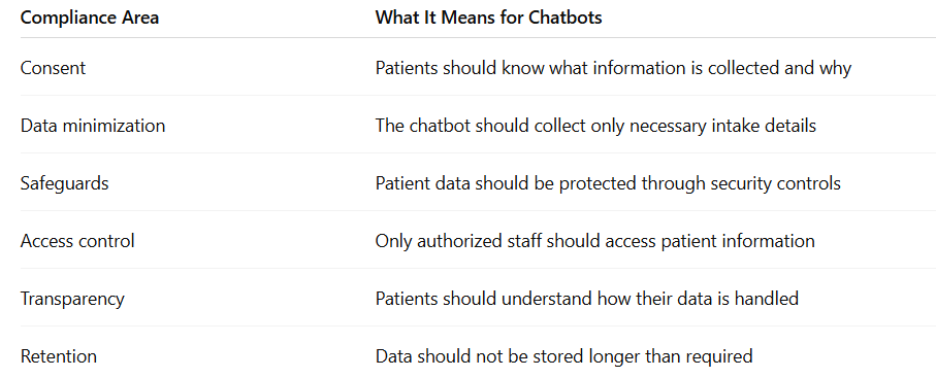
This is a practical overview, not legal advice. Healthcare organizations should consult legal or compliance experts before launching a chatbot that handles patient information.
Key Features Every Secure Patient Intake Chatbot Should Include
A healthcare chatbot is more than a chat window. It should support the care team’s workflow while protecting sensitive information.
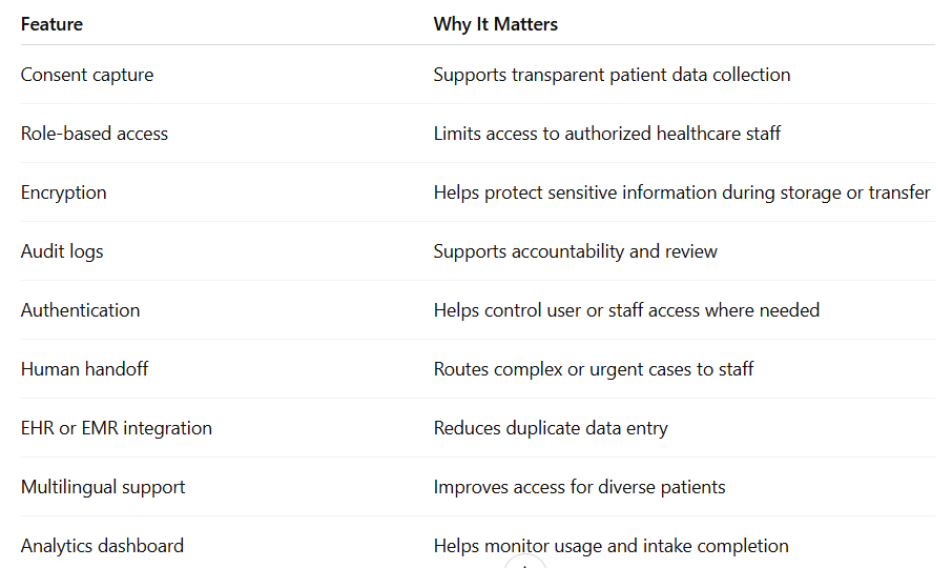
Security matters, but patients should still find the chatbot simple, clear, and easy to complete.
What Patient Intake Chatbots Should and Should Not Do
In healthcare, chatbot development needs clear safety limits. The system should support intake, not provide diagnosis or treatment advice.
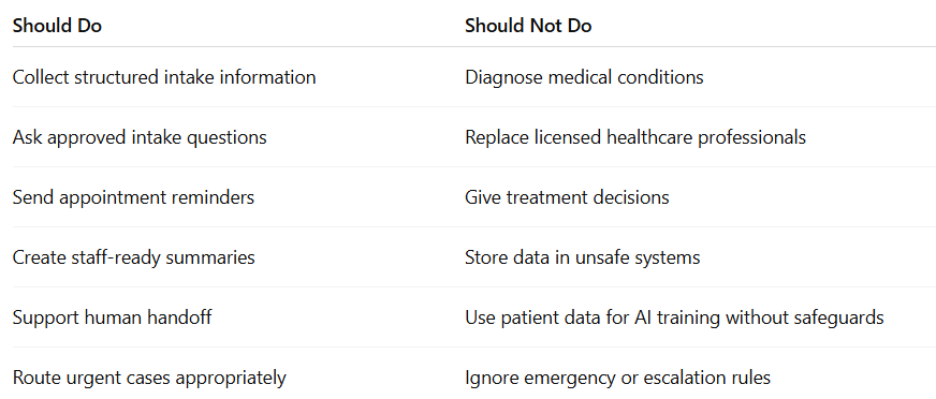
If the chatbot detects urgent symptoms or emergency-related responses, it should guide the patient to approved human support or emergency care instructions based on the provider’s workflow.
These limits help patients and staff use the chatbot with more confidence.
EHR, EMR, CRM, and Scheduling Integrations
A chatbot works better when it connects with the tools a clinic already uses. Without integration, staff may still need to copy patient details from one system to another.
A digital intake tool may integrate with:
- EHR or EMR platforms
- Appointment scheduling software
- CRM systems
- Patient portals
- Billing or insurance systems
- Email and SMS notification tools
- Telehealth platforms
Integration depends on available APIs, data mapping requirements, vendor permissions, and security review.
For organizations planning larger digital systems, healthcare software development solutions can help connect patient intake, secure workflows, clinical platforms, and administrative tools in one reliable ecosystem.
How Much Does a HIPAA-Compliant Patient Intake Chatbot Cost?
There is no single price for every healthcare chatbot because the cost depends on scope, features, integrations, and support needs. A simple intake chatbot with fixed questions will usually cost less than an AI-enabled chatbot with EHR integration, multilingual support, analytics, and advanced security workflows.
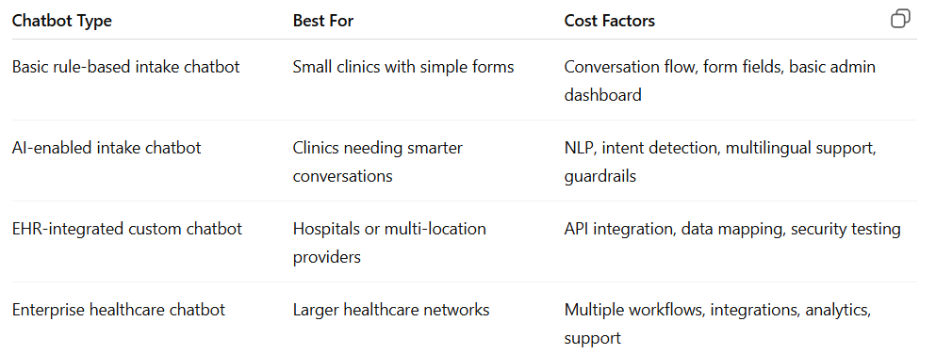
The main factors in healthcare chatbot development cost include AI complexity, conversation design, compliance planning, integrations, testing, hosting, maintenance, and post-launch support.
For Canadian healthcare providers, patient intake automation should be planned around long-term operational value, not only the initial build cost.
Custom Chatbot vs Ready-Made Healthcare Chatbot
Most teams compare two paths: using a ready-made chatbot or building a custom one.
A ready-made chatbot can work well for simple FAQs or basic intake. A custom chatbot may be a better fit when the organization needs unique intake forms, EHR integration, multilingual flows, role-based access, or advanced AI guardrails.
For businesses that need more flexibility, intelligent chatbot solutions in Canada can support tailored chatbot workflows for patient communication, intake automation, and healthcare operations.
ROI and Business Benefits of Patient Intake Automation
AI alone is not a reason to invest in a chatbot. The system should solve real operational problems.
A well-planned intake chatbot can help healthcare teams:
- Reduce repetitive front-desk questions
- Collect patient details before appointments
- Lower the chances of incomplete intake forms
- Give staff structured information before the visit
- Support 24/7 patient access
- Improve consistency across multi-location clinics
ROI depends on intake volume, staff workload, integration quality, and how easily patients use the chatbot. A better approach is to track real outcomes, such as completed forms, fewer manual calls, saved staff time, and fewer missing details.
Healthcare teams exploring broader automation can also consider AI-driven digital healthcare solutions to support virtual assistants, patient engagement, workflow automation, and secure healthcare platforms.
How to Choose the Right Intelligent Chatbot Development Partner
The right partner should understand both the software side and the day-to-day reality of healthcare operations. A general chatbot vendor can build a basic flow, but healthcare needs stronger planning around privacy, security, integrations, and patient safety.
Choose a partner that offers:
- Healthcare workflow understanding
- Experience in intelligent chatbot development
- Compliance-aware architecture practices
- EHR, EMR, CRM, or API integration capability
- Secure cloud development knowledge
- AI guardrail and human handoff planning
- Clear scope and documentation
- Post-launch support and optimization
- Canada-specific privacy awareness
This can reduce implementation risk and make the chatbot more useful for real healthcare workflows, not just generic automation.
Conclusion
A HIPAA-compliant chatbot for patient intake can help healthcare teams collect patient details earlier, reduce repetitive admin work, and make intake easier for patients. For a healthcare chatbot in Canada, privacy-aware design is important because providers need to consider HIPAA-style safeguards along with Canadian privacy expectations.
The best chatbot is not always the one with the longest feature list. It is the one that fits the workflow, protects patient data, connects with existing systems, and keeps staff in control. With experience in Web, Mobile, and Cloud solutions, Theta Technolabs can help healthcare organizations plan and build practical chatbot experiences with security, workflow, and integration needs in mind.
Build a Secure Patient Intake Chatbot with Theta Technolabs
Theta Technolabs helps healthcare providers, clinics, hospitals, telehealth companies, and digital health teams with intelligent chatbot development, healthcare chatbot development, workflow design, system integration, and secure digital platforms.
To discuss a secure patient intake chatbot for your healthcare organization, contact sales@thetatechnolabs.com.
FAQs
1. Can a chatbot collect patient health information?
Yes, a chatbot can collect patient health information when the workflow is designed with consent, secure access, privacy controls, and proper data handling. It should collect only the information required for the intake process.
2. Is HIPAA compliance enough for healthcare chatbots in Canada?
Not by itself. HIPAA is a U.S. healthcare privacy framework. Canadian healthcare providers should also consider PIPEDA and applicable provincial health privacy laws before launching a chatbot.
3. What affects healthcare chatbot development cost?
The main factors include chatbot complexity, AI features, number of intake flows, integrations, compliance requirements, hosting, multilingual support, analytics, testing, and ongoing maintenance.
4. Can a patient intake chatbot integrate with EHR or EMR systems?
Yes, a chatbot can integrate with EHR, EMR, CRM, scheduling, and patient portal systems when APIs and secure data workflows are available.
5. Should a healthcare chatbot provide diagnosis?
No. An AI chatbot for healthcare should support intake, collect structured information, and assist staff workflows. Diagnosis and treatment decisions should remain with licensed healthcare professionals.