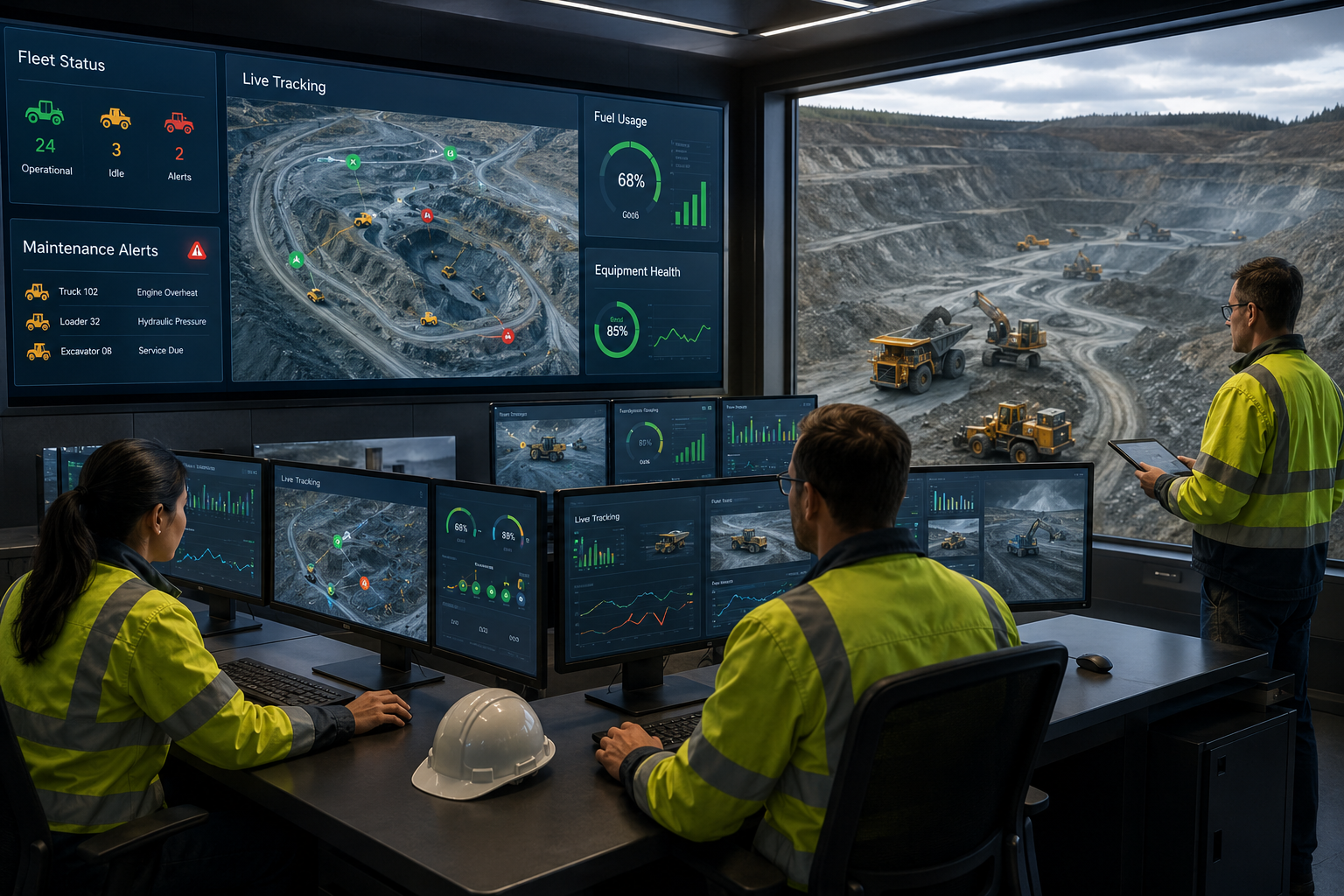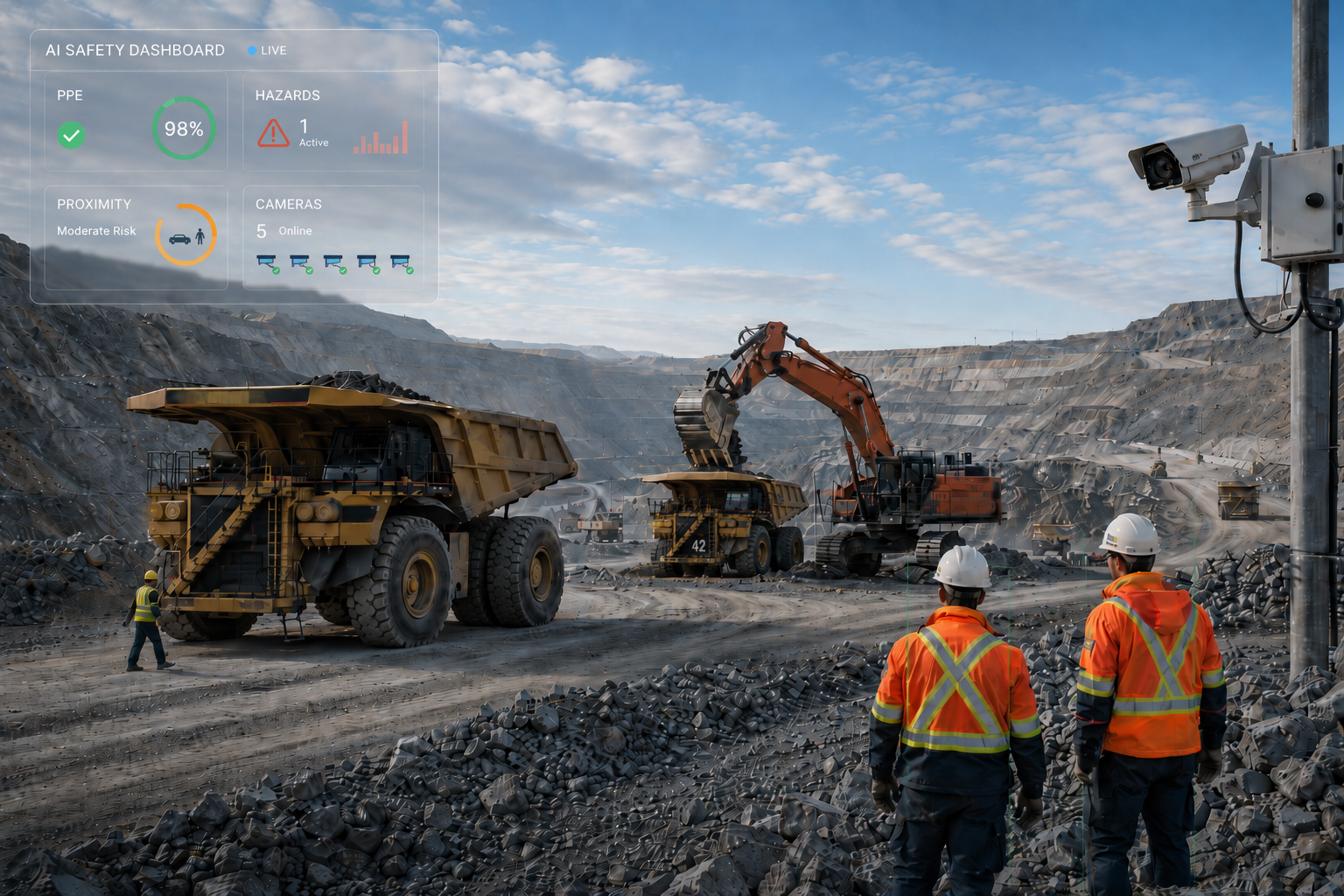


Mining environments are among the most complex industrial workplaces to monitor. Workers operate around heavy vehicles, drilling equipment, crushers, conveyors, loading zones, confined areas, and changing ground conditions. In Canada, where mining operations often extend across remote, underground, and harsh-weather locations, safety teams need more than routine inspections and recorded camera footage. They need faster visibility into risks before they become serious incidents.
This is where computer vision in mining safety becomes valuable. By using AI-powered cameras, video analytics, and automated alerts, mining companies can detect hazards such as PPE violations, restricted-zone entry, worker-equipment proximity risks, and unsafe movement in real time. According to Workplace Safety North, mining safety performance remains an important focus area because injury patterns, illness claims, and operational risks still need continuous attention. For companies exploring computer vision for mining safety Canada, the goal is not to replace safety teams. The goal is to give them better visibility, faster alerts, and stronger decision support.
Why Traditional Mining Safety Monitoring Is Not Enough
Many mining companies already use CCTV cameras, manual inspections, safety supervisors, and reporting systems. These tools are important, but they are often reactive. A camera may record an incident, but it cannot always prevent one unless someone is watching the footage at the right moment.
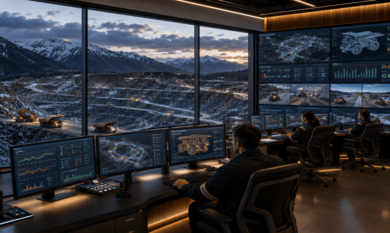
Manual monitoring also has practical limits. A supervisor cannot watch every haul road, tunnel, loading area, conveyor zone, and entry point at the same time. During busy shifts, small safety violations can go unnoticed. In underground or remote mining sites, visibility can become even harder because of dust, low lighting, equipment movement, and limited connectivity.
Common gaps in traditional safety monitoring include:
- CCTV footage is often reviewed after an incident.
- PPE violations may not be detected immediately.
- Workers may enter restricted areas without quick alerts.
- Blind spots around heavy vehicles increase safety risks.
- Manual inspections may not capture repeated near-miss patterns.
- Remote or underground zones are difficult to monitor continuously.
This is why mining safety technology Canada is moving toward smarter monitoring systems. Better worker safety monitoring in mining means safety teams can act sooner instead of depending only on after-the-fact reports.
What Is Computer Vision in Mining Safety?
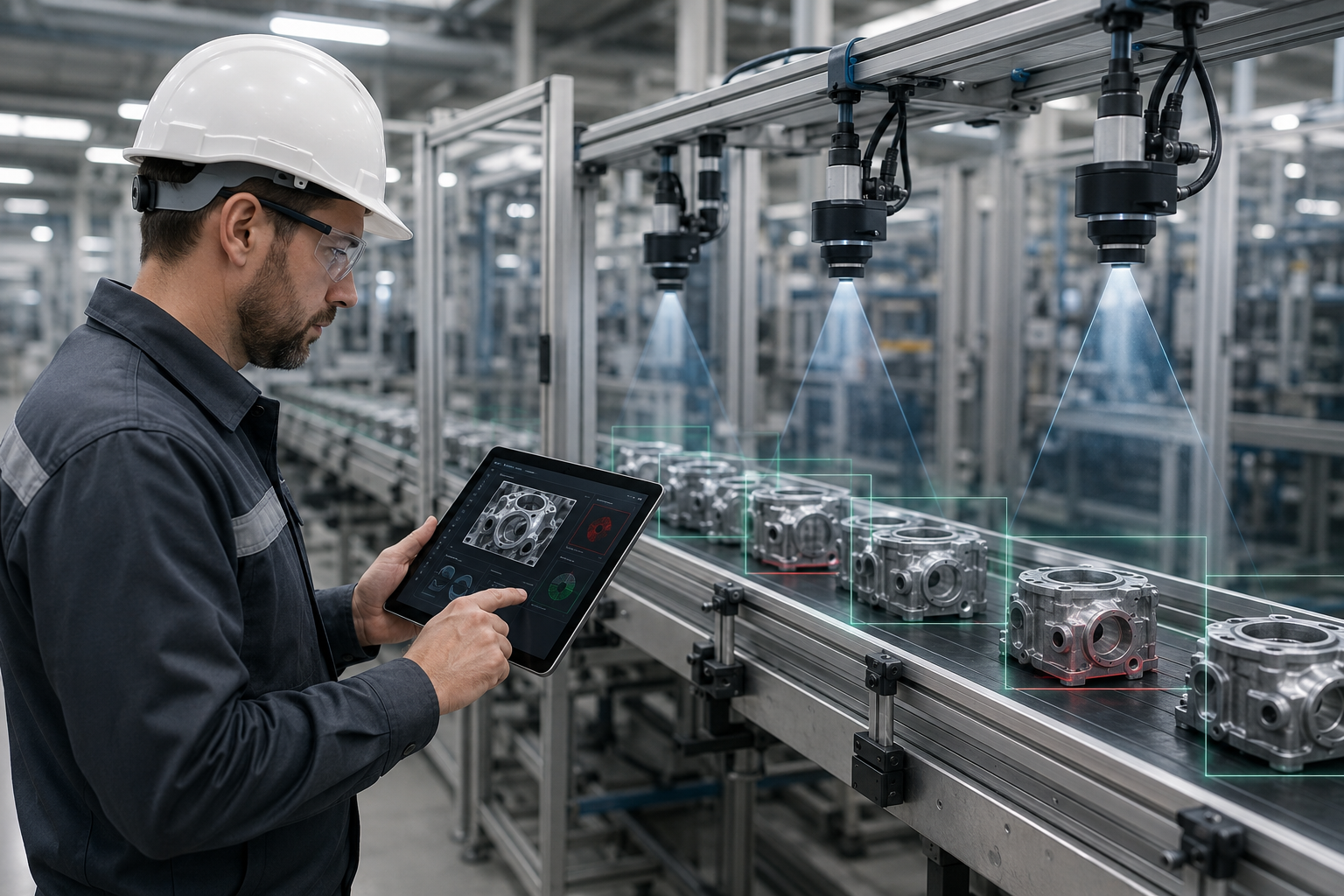
Computer vision is an AI technology that allows cameras to understand visual information. Instead of only recording video, a computer vision system analyzes images and live camera feeds to detect people, vehicles, PPE, movement patterns, unsafe zones, and unusual events.
In mining, this can turn existing cameras into intelligent safety tools. For example, the system can detect if a worker is missing a helmet, standing too close to a loader, entering a restricted conveyor zone, or remaining too long in a high-risk area. It can then send an alert to supervisors or safety teams.
For ethical use, mining companies should clearly communicate why visual monitoring is being used. The purpose should be worker safety, hazard prevention, and faster emergency response, not unnecessary surveillance or employee punishment. Where possible, systems can use privacy-focused methods such as role-based access, limited data retention, safety-only reporting, and face-blurring for non-critical footage.
Common Safety Hazards Computer Vision Can Detect
Computer vision can support mining safety teams by identifying visible hazards and unsafe activity across different areas of a site. It cannot remove every risk, and it should not be treated as a replacement for safety procedures, training, or human judgment. However, it can improve detection speed and consistency.
Some common hazards include:
- Missing helmets, reflective jackets, gloves, goggles, boots, or respirators
- Workers entering restricted zones near crushers, conveyors, or blasting areas
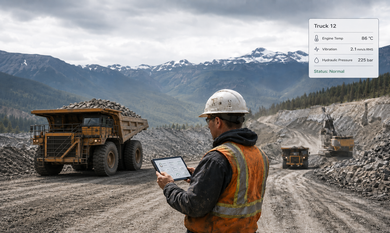
- People standing too close to haul trucks, loaders, excavators, or drilling machines
- Blind spot risks around large mining vehicles
- Workers standing under suspended loads
- Blocked emergency exits or unsafe access paths
- Overcrowding in confined or narrow work areas
- Unsafe movement near loading and unloading zones
- Slip, trip, fall, or abnormal posture indicators
- Unsafe dwell time in high-risk zones
This is especially useful for computer vision for PPE detection, where AI models can help identify missing protective equipment across monitored areas. It is also valuable for vehicle proximity detection in mining, because large equipment creates visibility challenges for both operators and workers.
Canadian workplace safety regulations include important areas such as protective equipment, confined spaces, moving vehicles, machinery, material handling, hazardous occurrence reporting, and hazard prevention programs. These categories are covered under the Canada Occupational Health and Safety Regulations, making real-time monitoring a practical support layer for safer operations.
How Computer Vision Detects Hazards in Real Time
A computer vision safety system works by connecting cameras, AI models, alerts, and reporting tools into one monitoring workflow. The process is usually simple from the user’s point of view.
- Cameras capture live video from the mining site.
- AI models analyze workers, vehicles, PPE, zones, and movement.
- The system detects unsafe activity or rule violations.
- Alerts are sent to supervisors, control rooms, or safety teams.
- The event is recorded with time, location, and visual evidence.
- Dashboards show incident history, repeated risks, and safety trends.
For example, if a worker enters a restricted crusher area, the system can identify the person, compare the movement with the safety boundary, and trigger an alert. This type of real-time hazard detection in mines helps teams respond earlier.
In harsh mining environments, model performance also depends on the quality of training data. Dust, low lighting, vibration, weather changes, camera angle, and underground visibility can affect detection accuracy. This is why computer vision systems should be tested and tuned using real site conditions before full-scale deployment.
Key Use Cases for Canadian Mining Companies
PPE Compliance Monitoring
PPE compliance is one of the most practical use cases for computer vision. The system can detect whether workers are wearing helmets, safety vests, goggles, gloves, or respirators in required areas. Research on computer vision for mining also highlights PPE detection and worker pose estimation as useful methods for improving miner safety and emergency response workflows. One example is this ScienceDirect study.
Restricted Zone Detection
Mining sites often have areas where entry must be controlled. These include conveyor belts, crushers, blasting zones, loading areas, unstable sections, and machine operating zones. Computer vision can create virtual boundaries and alert safety teams when someone enters without authorization.
Heavy Equipment Proximity Alerts
Large vehicles are essential in mining, but they also create serious blind spot risks. Computer vision can detect when a worker moves too close to haul trucks, loaders, excavators, or drilling machines. This supports faster intervention and safer movement around equipment.
Underground and Low-Visibility Monitoring
Underground mining environments can be difficult to monitor because of low light, narrow passages, dust, and limited visibility. Computer vision can help detect people, movement, and unsafe activity in monitored areas, especially when combined with suitable cameras and edge AI devices.
Safety Incident Reporting
Computer vision systems can automatically record safety events with timestamps, camera location, and visual evidence. This helps safety managers review patterns, identify repeated risk zones, and improve training or site procedures.
For Canadian mining companies, these use cases make computer vision for mining safety Canada a practical investment area, especially where operations involve remote sites, underground work, heavy equipment, and strict safety expectations.
Why Edge AI Matters for Remote and Underground Mining Sites
Many mining sites cannot rely fully on cloud connectivity. Remote locations, underground tunnels, and large operating areas may face network limitations. In these cases, edge AI for mining sites becomes important.
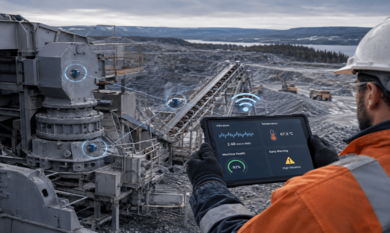
Edge AI processes video data closer to the camera or device instead of sending everything to the cloud. This can help mining teams receive alerts faster and reduce dependency on continuous internet connectivity.
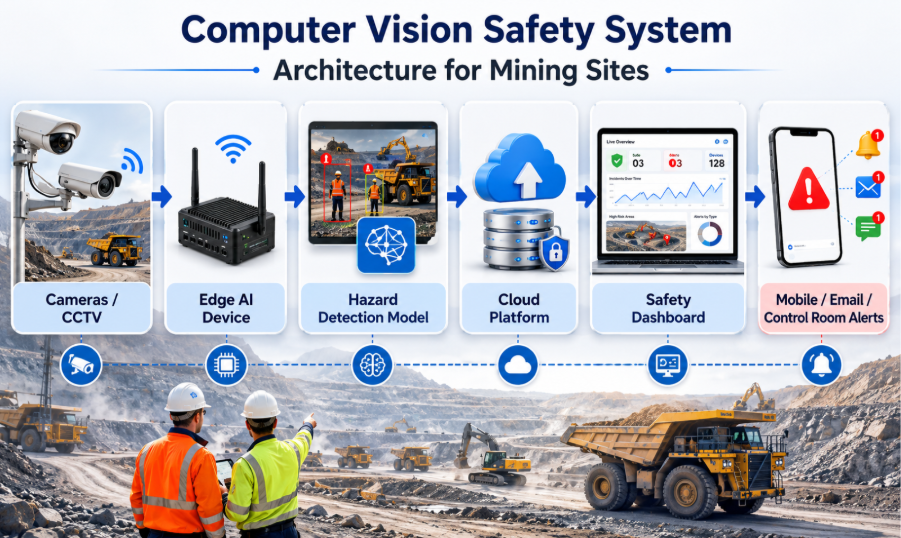
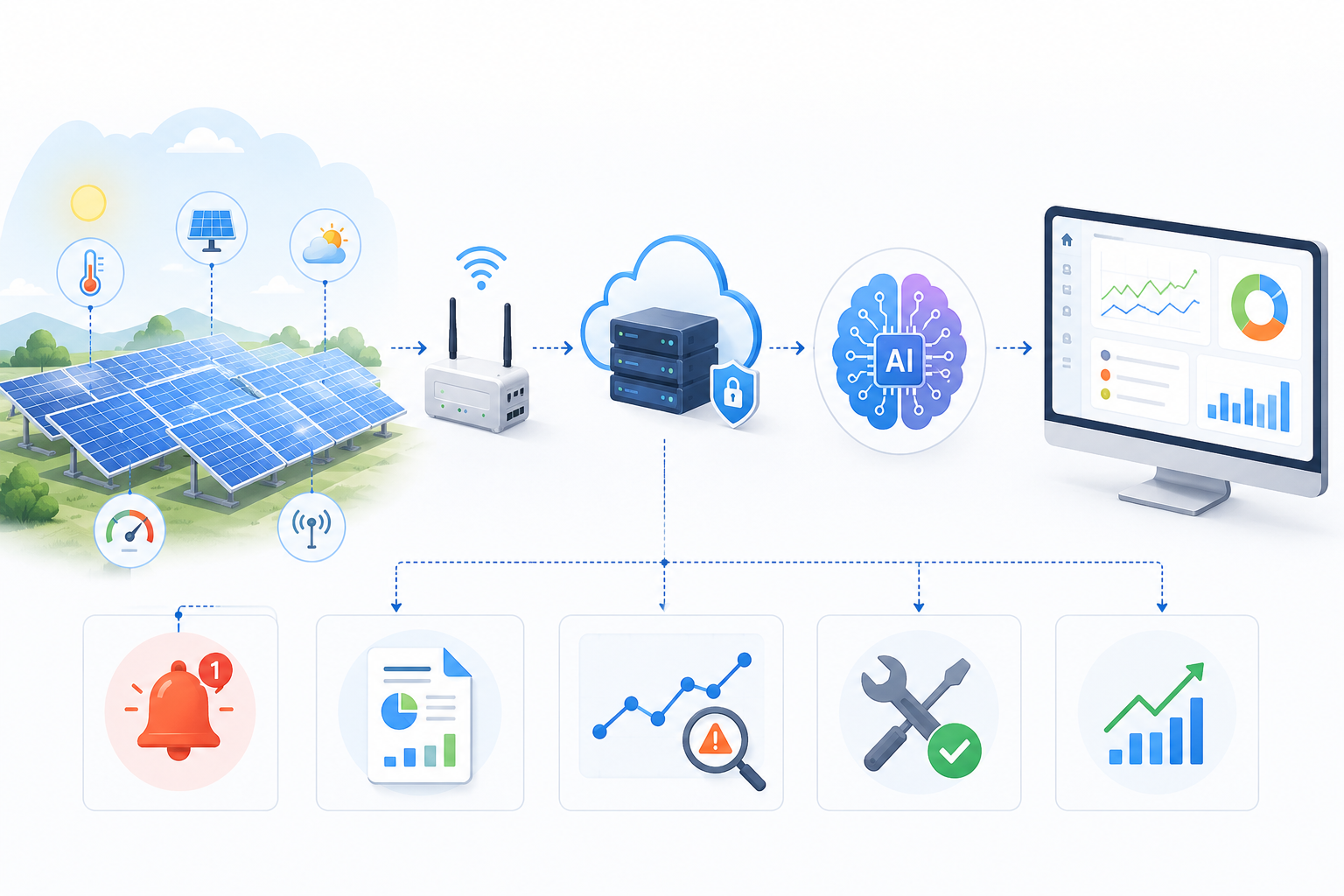
Figure: Computer vision safety system architecture for mining sites, showing how camera feeds move through edge AI, hazard detection models, cloud platforms, dashboards, and real-time alerts.
Key benefits include:
- Faster hazard detection
- Lower alert latency
- Reduced cloud bandwidth usage
- Better support for remote mining sites
- Local processing of safety events
- More reliable monitoring in low-connectivity areas
For mining companies, edge AI can make safety monitoring more practical where cloud-only systems may struggle.
Business Benefits of Computer Vision for Mining Safety
The value of computer vision is not only technical. It also supports safety, operational, and management goals.
The real value of computer vision in mining safety is that it helps teams identify risks earlier. It does not guarantee zero incidents, but it can support faster response, better documentation, and stronger safety workflows. For leaders evaluating mining safety technology Canada, this makes computer vision a practical part of digital safety transformation.
Implementation Roadmap for Mining Companies
A computer vision project should start with safety priorities, not technology features. Mining companies should first identify where visual monitoring can reduce real operational risk.
A practical roadmap can look like this:
- Identify high-risk mining zones, such as haul roads, loading areas, conveyors, crushers, and underground entries.
- Review existing CCTV coverage, camera quality, lighting, and blind spots.
- Select hazard categories, such as PPE detection, restricted-zone entry, and vehicle proximity.
- Train or customize computer vision models for the site environment.
- Run a pilot in one high-risk area before scaling.
- Connect alerts to supervisors, control rooms, or safety teams.
- Build dashboards for incident logs, heatmaps, and safety trends.
- Scale the solution across open-pit, underground, and remote locations.
Mining companies planning long-term digital safety transformation can also connect vision systems with dashboards, alert workflows, and reporting platforms through custom mining software development services. This makes the solution more useful than a standalone camera tool.
In a mining environment, a computer vision model may perform well in clear daylight but generate more false alerts in dusty, low-light, or underground areas. During a pilot, safety teams can review these alerts, identify where the model is misreading shadows, reflective gear, or equipment movement, and retrain the model with more site-specific images. This helps improve alert quality before the system is scaled across more zones.
Why Custom Computer Vision Development Matters
Generic safety tools may not fit every mining environment. Each site has different layouts, hazards, camera positions, PPE rules, lighting conditions, and reporting requirements. A system that works in one open-pit mine may not work the same way in an underground operation.
Custom development matters because it allows the solution to match the actual mining workflow. The AI model can be trained for specific hazards, camera angles, worker movement, and equipment types. Alerts can also be connected to the systems that safety teams already use.
Data security should also be part of the system design. Mining companies should define who can access safety footage, how long incident data is stored, and how alerts are shared across teams. A well-built system should support safety reporting while protecting worker privacy and operational data.
Custom computer vision solutions can support:
- Site-specific hazard detection
- Different PPE requirements by zone
- Open-pit and underground monitoring needs
- Edge AI deployment for remote areas
- Integration with HSE, ERP, mobile, or cloud systems
- Custom dashboards for safety managers and operations teams
This approach makes AI hazard detection in mining more practical, better tuned to site conditions, and aligned with real safety workflows.
Conclusion:
Mining safety depends on visibility, speed, and consistent action. Traditional cameras and manual inspections are still useful, but they are not always enough for fast-moving, high-risk environments. With computer vision in mining safety, Canadian mining companies can detect hazards earlier, monitor PPE compliance, identify restricted-zone violations, track vehicle proximity risks, and improve safety reporting.
Theta Technolabs helps businesses build practical AI solutions supported by Web, Mobile, and Cloud capabilities. With the right technology partner, mining companies can move from manual observation to proactive safety intelligence through custom computer vision development services Canada.
Build Safer Mining Operations
If your mining business is planning to improve hazard detection, site visibility, and safety reporting, Theta Technolabs can help you build a custom computer vision solution for real mining workflows.
Our team can support computer vision development, custom software development, web application development, mobile app development, cloud consulting, safety dashboards, real-time alert systems, and secure data workflows. To discuss your mining safety technology requirements, contact us at sales@thetatechnolabs.com.