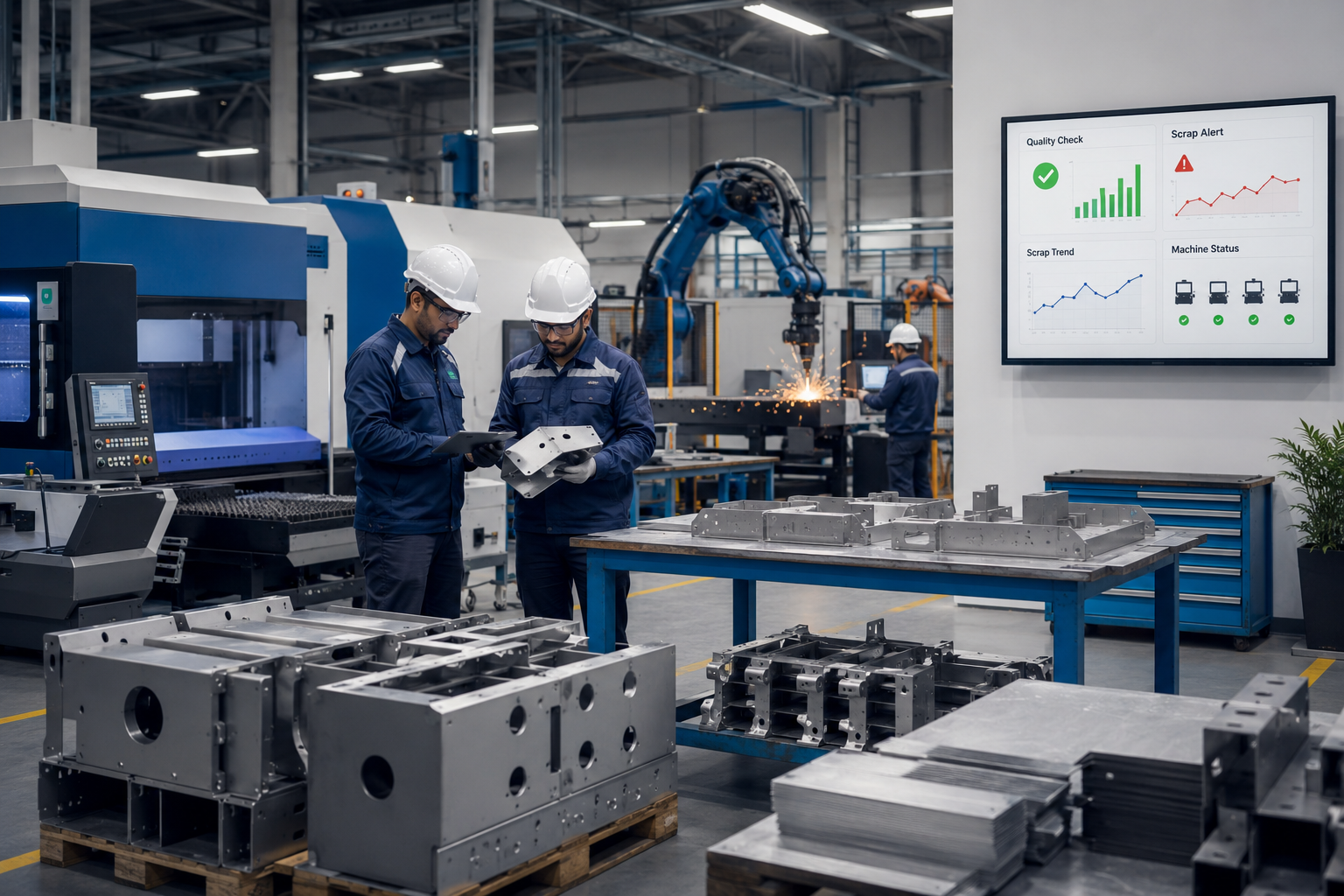


Machine learning helps metal fabrication units reduce scrap by finding defect patterns, predicting quality risks, and improving process settings before waste increases.
Scrap cost is one of the most direct losses in metal fabrication. Every rejected part represents material cost, machine time, labour, and energy that cannot be recovered. For fabrication units working on tight margins, even a modest improvement in scrap rate reduction in manufacturing can make a meaningful difference to profitability and production planning.
Traditional inspection catches defects after they happen. By that point, the waste is already created. Machine learning for scrap rate reduction works differently. It uses production data to find patterns connected to poor quality, often before the defect reaches final inspection. When fabrication units already have production data available, ML gives quality and operations teams a structured way to act on it earlier in the production cycle.
Why Scrap Happens in Metal Fabrication
Scrap in metal fabrication is rarely caused by one isolated reason. It usually builds from process variation across multiple stages. Common causes include wrong cutting speed settings, welding heat variation, progressive tool wear, material thickness differences between batches, bending pressure inconsistencies, machine vibration, poor inspection timing, and shift-to-shift variation in process execution.
This is not about blaming workers. Most scrap comes from small variations in machine settings, material condition, and process gaps that are genuinely difficult to catch manually during a full production shift. Metal fabrication quality control becomes harder as volume increases because more variables interact across more machines, more shifts, and more material batches. The problem is systemic, not individual.
Where Machine Learning Fits in the Fabrication Process
Machine learning in metal fabrication studies both historical and live production data to find patterns that are not easy to detect through manual review. It can compare machine settings, material batch records, inspection outcomes, defect history, maintenance logs, operator shift data, sensor signals, and scrap reports together within one model.
This multi-source comparison is what makes ML genuinely useful. A quality team might suspect that a specific machine or material batch is connected to higher rejection, but confirming it clearly across weeks of production data requires more than manual analysis alone.
For fabrication companies planning digital upgrades, connected manufacturing software solutions can help bring machine data, quality records, and production dashboards into one unified system. This data infrastructure is what makes production data analytics and machine learning practical to implement at a shop-floor level.
Main Use Cases of Machine Learning for Scrap Reduction
Defect prediction: ML models can identify early warning patterns in process conditions before defects appear at final inspection. This supports predictive quality control by flagging risk conditions earlier, giving teams time to intervene.
Tool wear detection: Vibration data, temperature signals, sound patterns, and machine performance trends can indicate progressive tool wear. Detecting this early helps teams replace tooling before it starts producing defective parts, directly helping reduce rework and scrap.
Machine parameter optimisation: ML can analyse which combinations of cutting speed, feed rate, welding current, bending pressure, or temperature settings consistently produce better quality outcomes. Teams can use these insights for ongoing process improvement rather than relying on fixed settings alone.
Computer vision inspection: Cameras paired with ML models support AI-based defect detection in metal fabrication by identifying cracks, weld defects, surface marks, edge problems, dents, alignment issues, and dimensional deviations consistently. This is faster and more reliable than manual visual checks at higher production volumes.
Root cause analysis: When scrap rates rise unexpectedly, ML can help connect the pattern to specific machines, shifts, material batches, or process conditions. This structured approach saves time and reduces guesswork for quality managers.
What Data Is Needed Before ML Can Work
Machine learning cannot work properly without clean, consistent, and useful data. This is an important and honest point for any fabrication unit considering machine learning for manufacturing.
Useful data sources include CNC machine data, sensor data, ERP or MES outputs, quality inspection reports, scrap logs, rework records, maintenance history, material batch records, and operator shift records. Data should be labelled properly so the model understands which production conditions are linked to defects. Historical defect records are particularly valuable for training.
Manual logs often need cleaning before they can be used reliably. Starting with a focused pilot project on one machine, one process, or one defect type is more practical than attempting a large rollout from the beginning.
Simple Workflow: How ML Reduces Scrap
Here is a practical workflow showing how machine learning supports scrap reduction in a fabrication unit:
- Collect production and quality data from machines, sensors, inspection, and ERP systems
- Clean and organise the data for consistency and accuracy
- Train the ML model on historical scrap patterns and defect records
- Monitor live production signals against trained patterns
- Detect risk conditions that match known defect patterns
- Alert supervisors or quality teams with real-time notifications
- Adjust process settings based on ML recommendations
- Track scrap reduction outcomes over time and refine the model
This workflow shows how predictive analytics for scrap reduction shifts teams from reactive inspection toward earlier, more informed intervention.
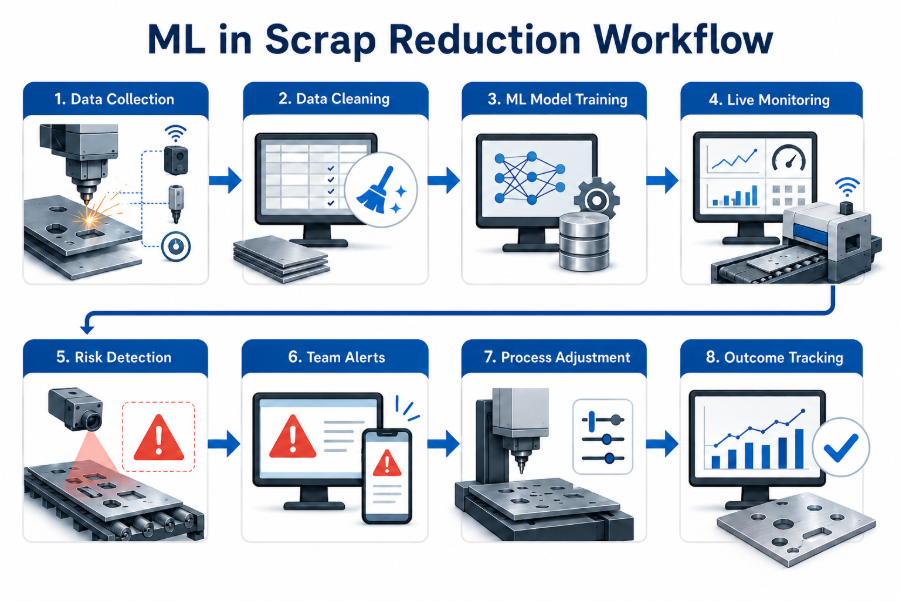
Figure: Machine learning workflow for reducing scrap in metal fabrication units
Business Value for Fabrication Units
When implemented with proper data and process discipline, machine learning can support lower material waste, reduced rework hours, better production planning, improved delivery reliability, fewer rejected parts, better raw material usage, improved quality consistency, and stronger shop-floor visibility.
ML may not remove every defect, but it can help teams reduce avoidable scrap when the right data, process discipline, and shop-floor adoption are in place. The practical value lies in improving production efficiency and giving quality teams better information at the right time.
Common Mistakes to Avoid
- Starting ML without clean or labelled data
- Expecting fast results without a proper pilot phase
- Ignoring quality team feedback during model development
- Relying only on dashboards without connecting alerts to actual process changes
- Using ML without building a human review process for alerts
- Failing to monitor model performance after deployment
- Not training shop-floor teams on how to use the system properly
These mistakes are common and can significantly reduce the value of an otherwise well-planned ML implementation.
Practical Example Scenario
Consider a sheet metal fabrication unit experiencing repeated rejections during bending and welding operations. The team collects historical scrap records, machine settings, material batch data, inspection results, and maintenance logs. Analysis reveals that certain combinations of material thickness variation and heat settings are consistently linked with higher defect rates across specific shifts.
With an ML model in place, the system can flag similar patterns earlier in the production run. Supervisors can then adjust settings before more parts are wasted. This is not a guaranteed outcome. It represents a realistic and achievable improvement when the data foundation is sound, the team is trained, and the process for acting on alerts is clearly defined.
Conclusion
Machine learning helps fabrication units move from reactive inspection to predictive quality control. It supports better decisions without replacing human expertise. It works best when the data is clean, the process discipline is consistent, and the shop-floor team is involved from the beginning.
How machine learning reduces scrap in metal fabrication is not about automation replacing judgement. It is about giving quality and production teams better information at the right time, so avoidable waste can be reduced systematically.
Theta Technolabs supports manufacturers with practical machine learning services that connect data, quality workflows, and production systems for smarter decision-making across the shop floor.
Partner With Theta Technolabs
Theta Technolabs builds practical technology solutions for manufacturing teams. Our capabilities include ML model development, manufacturing dashboards, quality monitoring systems, production data integration, and custom software support for fabrication units. We work across web, mobile, and cloud platforms to connect your shop-floor data with actionable insights.
If you are looking to reduce scrap, improve quality control, or build a reliable data foundation for manufacturing decisions, our team is ready to support you.
Contact us at sales@thetatechnolabs.com
Frequently Asked Questions
1. How does machine learning reduce scrap in metal fabrication?
Machine learning analyses production and quality data to detect patterns linked to defects. It predicts risk conditions early in the process, helps optimise machine settings, and supports faster root cause analysis, all of which help teams reduce avoidable scrap over time.
2. Can machine learning completely remove scrap?
No. Machine learning can help reduce avoidable scrap by improving process visibility and enabling earlier detection, but it cannot guarantee zero defects. Results depend on data quality, process discipline, and how consistently the team acts on the insights it generates.
3. What data is needed for scrap rate reduction?
Useful data includes machine and sensor readings, quality inspection records, scrap logs, rework records, material batch details, maintenance history, and operator shift records. Clean and well-labelled data is essential before any ML model can be trained effectively.
4. Is machine learning useful for small fabrication units?
Yes, provided they start with one focused use case such as welding defects, cutting errors, bending issues, or tool wear. A targeted pilot project is more practical and manageable than a large-scale rollout at the start.
5. What is the role of computer vision in scrap reduction?
Computer vision uses cameras and ML models to inspect surfaces, welds, edges, cracks, dents, and dimensions consistently and at production speed. It helps detect visible defects more reliably and at a higher frequency than manual inspection alone, especially as production volumes grow.