Fintech apps in Canada are expected to do more than process transactions. Users now expect fast approvals, secure payments, personalized insights, smooth support, and reliable fraud protection. At the same time, fintech companies need to manage risk, protect sensitive financial data, and scale operations without creating unnecessary friction for users.
Many fintech apps start with fixed rules, manual checks, and basic dashboards. These systems may work in the early stage, but they can become limited as the app grows. More users, higher transaction volumes, changing fraud patterns, and stronger customer expectations can expose gaps in the product.
This is where machine learning for fintech apps becomes valuable. A fintech app machine learning upgrade can help businesses move from reactive systems to smarter, data-driven workflows. The goal is not to add AI only because it sounds advanced. The goal is to solve real business problems with better fraud detection, personalization, risk scoring, support automation, and predictive analytics.
Why Fintech Apps Need Smarter ML Capabilities
Fintech companies handle sensitive processes such as identity checks, transaction monitoring, lending decisions, payment activity, account support, and risk analysis. When these processes depend only on static rules or manual reviews, teams may struggle to respond quickly and accurately.
In Canada, responsible AI adoption is also important for financial organizations. OSFI and FCAC have discussed how AI is advancing quickly and how financial institutions need to monitor the changing risk landscape while supporting responsible adoption.
For fintech companies in Canada, machine learning should therefore be built with security, explainability, privacy, and governance in mind. Strong AI-powered fintech solutions are not only about automation. They should help teams make better decisions while keeping human oversight for sensitive financial cases.
Machine learning can support fintech apps in areas such as:
- Fraud detection
- User personalization
- Credit and risk scoring
- Customer support automation
- Predictive analytics
Sign 1: Your Fraud Detection Still Depends on Fixed Rules
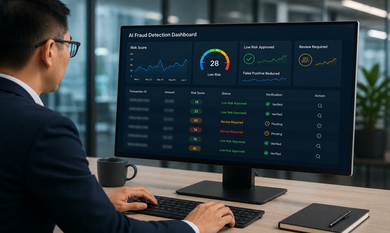
One of the first signs your fintech app needs machine learning is that fraud detection still depends mainly on fixed rules. For example, your system may flag transactions above a certain amount, block activity from certain locations, or trigger alerts based on repeated failed attempts.
These rules can help with known risks, but fraud patterns change quickly. Suspicious activity may appear through unusual login behavior, device changes, transaction timing, repeated small payments, or location mismatches. A rule-based system may miss these patterns if they do not match pre-set conditions.
This is where machine learning can improve fintech fraud detection. Machine learning models can analyze transaction behavior, account activity, device signals, and user patterns to detect unusual activity faster. It can also support risk scoring, so teams can prioritize high-risk cases instead of treating every alert the same way.
Rule-Based Fraud Checks
ML-Based Fraud Detection
Works on fixed conditions
Learns from transaction and behavior patterns
May miss new fraud behavior
Can identify unusual activity signals
Can create unnecessary false alerts
Can support better risk scoring
Needs frequent manual rule updates
Can improve with monitored data updates
Machine learning does not eliminate fraud completely. However, when designed and monitored properly, it can help fintech teams detect risk earlier and reduce dependence on static fraud rules.
Sign 2: Every User Gets the Same App Experience
Another clear sign is that every user receives the same app experience. If all users see the same dashboard, same alerts, same product suggestions, and same financial insights, the app may feel basic.
Modern fintech users expect digital financial platforms to understand their needs. A student, small business owner, investor, freelancer, and salaried professional may all use the same app, but their financial behavior and goals are different.
Fintech app personalization can help improve engagement by making the experience more relevant. Machine learning for fintech apps can study user behavior, transaction history, spending patterns, app activity, and financial goals to provide more useful insights.
Personalized fintech experiences may include:
- Spending insights based on user behavior
- Smart saving suggestions
- Relevant product recommendations
- Risk-based alerts
- Personalized onboarding flows
- Custom dashboard views
This personalization should be handled responsibly. Fintech companies must protect user data and avoid intrusive experiences. The purpose should be to make the product more helpful, not to overwhelm users with unnecessary recommendations.
Sign 3: Credit, Risk, or Approval Decisions Are Too Slow
If your fintech app handles lending, BNPL, payments, insurance, wealthtech, or digital banking, slow risk decisions can affect user experience and business growth. Manual checks, static scoring systems, and disconnected data can delay approvals or create inconsistent decisions.
For example, a lending app may take too long to review applications. A payment app may struggle to separate low-risk users from high-risk users. A wealthtech platform may not segment users properly based on behavior and risk profile.
ML-based credit risk scoring can help fintech companies analyze patterns that traditional scoring systems may miss. Machine learning can support repayment prediction, customer risk segmentation, transaction risk analysis, and automated decision support.
Useful ML applications in this area include:
- Credit risk scoring
- Repayment behavior prediction
- Customer risk segmentation
- Transaction risk analysis
- Underwriting support
- Approval workflow prioritization
However, machine learning should not replace responsible financial oversight. Sensitive financial decisions should include explainability, auditability, and human review where needed. The best approach is to use ML as a decision-support layer, not as an unchecked decision-maker.
Sign 4: Your Support and Operations Teams Are Overloaded
As fintech apps grow, support teams often receive repeated questions about failed transactions, payment status, refunds, account verification, login issues, onboarding, wallet access, and dispute updates. If every issue needs manual handling, response times become slower and support costs increase.
This is another sign that your fintech app may need modernization. Machine learning can support operations by identifying customer intent, classifying tickets, routing issues, and prioritizing urgent cases.
An AI chatbot for fintech customer support can help answer common questions, guide users through basic processes, and reduce pressure on support teams. For example, a chatbot can help users check transaction status, understand verification steps, or raise a support request.
Common fintech support issues include:
- Failed or pending transactions
- Account verification questions
- Login and access issues
- Refund or dispute updates
- Payment status requests
- Onboarding confusion
AI chatbots should not fully replace human support. Sensitive financial issues, complaints, fraud concerns, and complex account problems should still move to trained human teams. A responsible support system uses automation for repetitive work and human support for high-impact cases.
Sign 5: Your App Collects Data but Does Not Predict Anything
Many fintech apps collect large amounts of data. This may include transaction history, user behavior, login activity, product usage, payment activity, support interactions, and risk signals. But collecting data is not the same as using it intelligently.
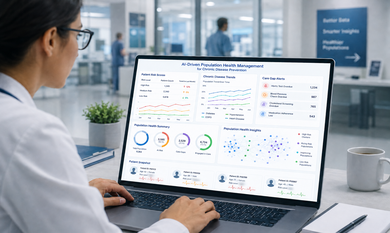
If your app only shows past reports and static dashboards, it may not be using its data fully. Basic dashboards tell teams what already happened. Predictive analytics in fintech helps teams understand what may happen next.
Machine learning can help predict customer churn, fraud risk, repayment issues, product demand, user engagement, lifetime value, and support needs. This helps fintech leaders make faster and more informed decisions.
Current Data Use
ML Upgrade Opportunity
Past transaction reports
Fraud risk prediction
Basic dashboards
Personalized financial insights
Manual churn review
Churn prediction
Static risk records
Predictive risk scoring
Support history
Predictive support alerts
This does not mean predictions will always be perfect. Predictive models depend on data quality, model design, monitoring, and regular improvement. Still, if your fintech app has useful data but cannot generate forward-looking insights, it may be ready for a machine learning upgrade.
Machine Learning Upgrade Checklist for Fintech Apps
Your fintech app may need a machine learning upgrade if:
- Fraud alerts are inaccurate or delayed
- Genuine users are blocked too often
- Every user receives the same app experience
- Risk decisions are manual, slow, or inconsistent
- Support teams handle too many repetitive queries
- Dashboards only show historical data
- The app cannot predict churn, fraud risk, or customer behavior
- Your competitors are offering smarter AI-powered fintech features
Before moving into full ML implementation, fintech teams can quickly review whether their current app shows these common upgrade signals. The checklist below highlights the key signs that may indicate the need for smarter, data-driven capabilities.
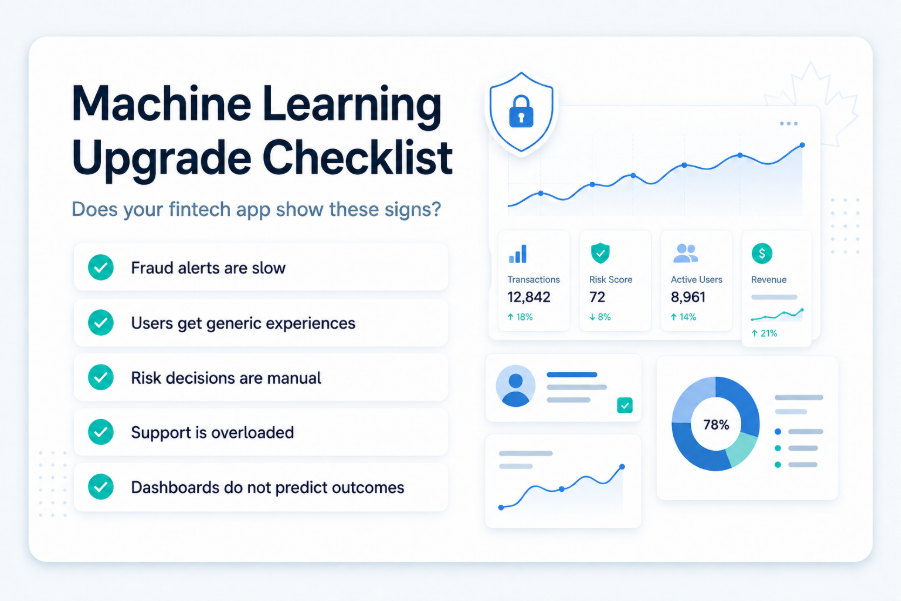
Figure: Machine learning upgrade checklist for fintech apps
This checklist helps fintech leaders identify whether the problem is only operational or whether the app needs deeper fintech app modernization.
What to Consider Before Upgrading Your Fintech App with ML
Machine learning should be added with a clear purpose. It should solve a real problem such as fraud detection, personalization, credit scoring, support automation, or predictive analytics.
Before investing in machine learning development services in Canada, fintech companies should consider:
- Data quality
ML models need clean, relevant, and structured data to produce useful results.
- Privacy and security
Financial data must be protected through secure storage, access control, encryption, and responsible data handling.
- Model explainability
Teams should understand why a model gives a certain risk score, recommendation, or prediction.
- Compliance readiness
Fintech companies should align ML adoption with internal risk, audit, and compliance processes.
- API and cloud infrastructure
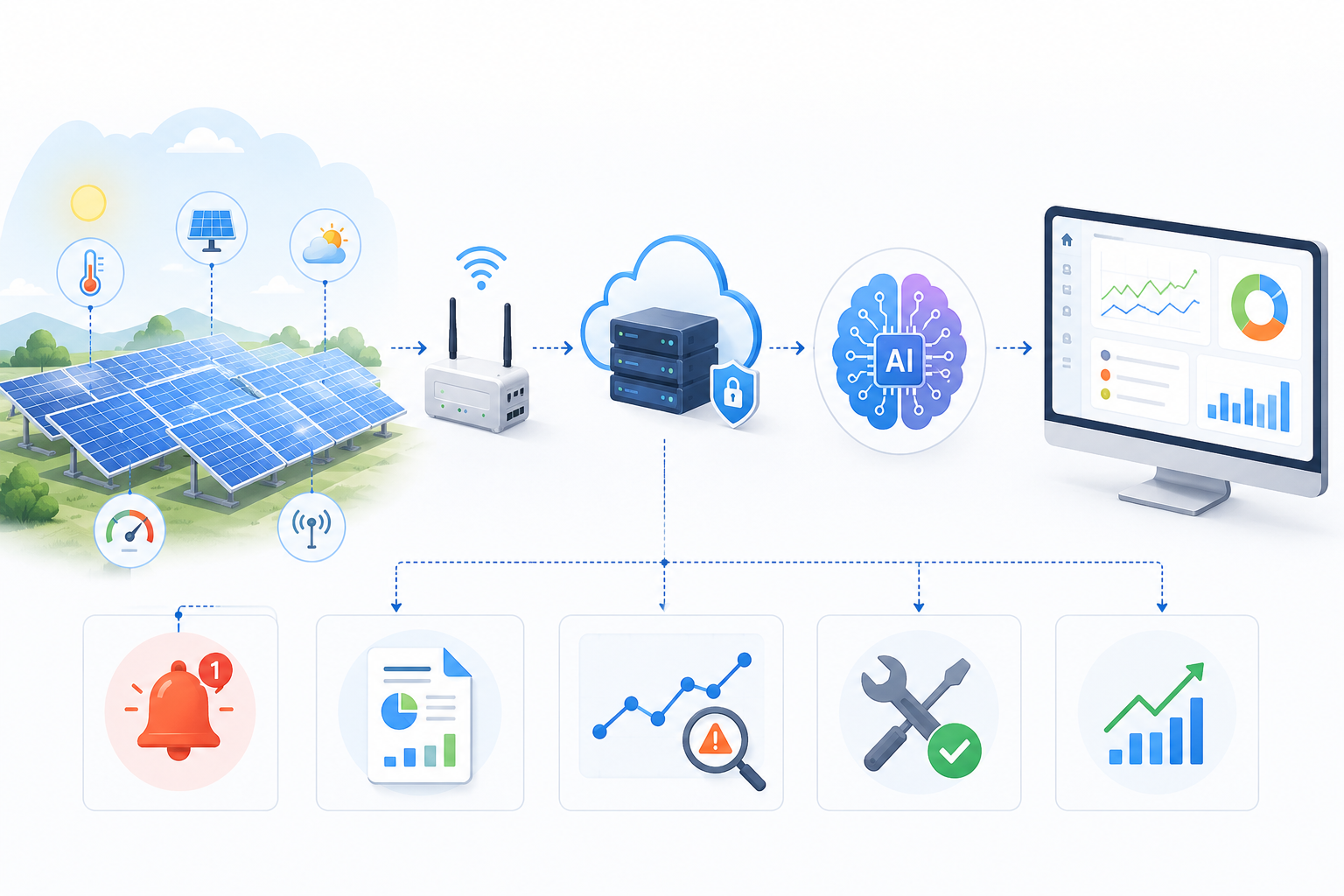
ML features need reliable integration with the existing app, data systems, dashboards, and cloud environment.
- Human review
High-risk financial decisions should include human oversight.
- Model monitoring
ML models should be reviewed after launch to check accuracy, drift, and performance.
A practical approach is to start with one high-value use case instead of trying to automate everything at once.
Frequently Asked Questions
1. How do I know if my fintech app needs machine learning?
Your fintech app may need machine learning if fraud detection is slow, users receive generic experiences, risk checks depend on manual review, support teams are overloaded, or dashboards only show past data. A fintech app machine learning upgrade is useful when the app needs smarter, faster, and more predictive workflows.
2. What is the best first machine learning feature for a fintech app?
Fraud detection is often a strong starting point because it directly affects security and user trust. However, the best first feature depends on your business problem. Machine learning for fintech apps can also begin with personalization, credit scoring, customer segmentation, support automation, or predictive analytics.
3. Can machine learning improve fintech fraud detection?
Yes, machine learning can support fintech fraud detection by identifying unusual transaction patterns, login behavior, device signals, and risk activity. It can help teams detect suspicious behavior faster, but it should be monitored regularly and should not be treated as a complete fraud-prevention replacement.
4. Is machine learning useful for small or growing fintech companies in Canada?
Yes, machine learning in fintech Canada can be useful for small and growing companies when the use case is focused. A company does not need to build a large AI system first. It can start with fraud alerts, support automation, customer segmentation, churn prediction, or personalization.
5. What should fintech companies consider before using ML?
Fintech companies should review data quality, privacy, security, explainability, compliance readiness, integration complexity, and model monitoring. Fintech app modernization should be planned carefully so machine learning supports better decisions without removing necessary human oversight.
Conclusion
A fintech app does not need machine learning only because AI is popular. It needs machine learning when current systems can no longer support the product’s growth, risk, and user experience needs.
If your app depends on fixed fraud rules, gives every user the same experience, delays risk decisions, overloads support teams, and collects data without making predictions, it may be time to consider machine learning for fintech apps.
For Canadian fintech companies, the goal should be secure, scalable, and responsible innovation. A well-planned ML upgrade can help fintech teams improve fraud monitoring, personalization, decision support, operations, and predictive intelligence while keeping user trust at the center.
Upgrade Your Fintech App with Machine Learning Support
Theta Technolabs helps fintech companies plan and build intelligent digital products with machine learning, web, mobile, cloud, dashboard, and analytics capabilities. As a fintech software development company in Canada, it can support fintech app modernization, ML integration, support automation, and predictive analytics development.
If you want to explore machine learning development for your fintech app, contact sales@thetatechnolabs.com.