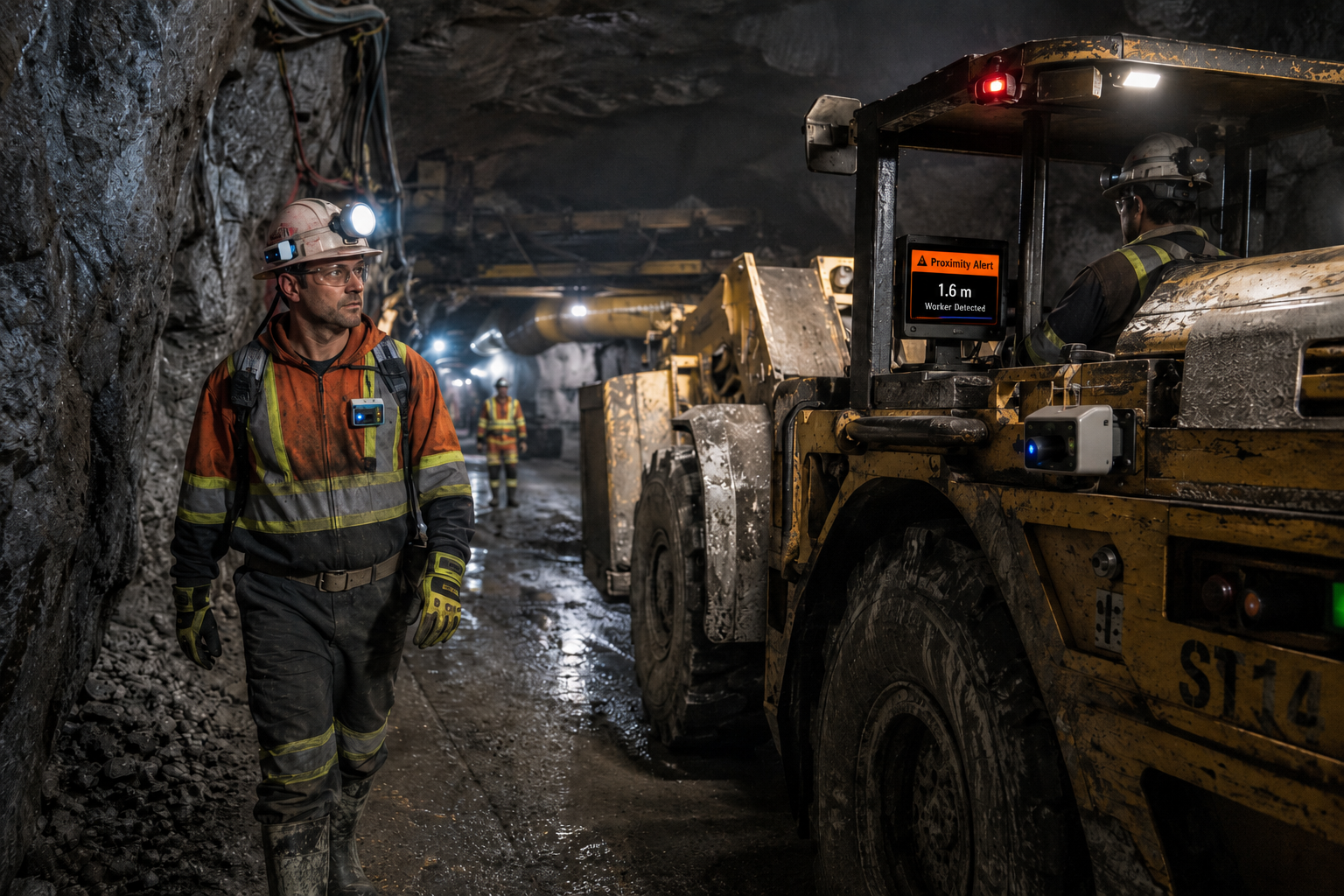


Underground mines are dangerous places to work. Machines and people share tight, dark tunnels, and a worker on foot can easily end up in the path of a moving loader before either one sees the other. BLE proximity monitoring helps prevent these moments by warning workers and operators when they get too close. This blog explains how BLE proximity monitoring can improve underground worker safety, where the technology works well, where it needs support from other tools, and how it fits Canadian mines. For a broader view, our guide to proximity detection in mining covers the basics.
Why Underground Mines Are So Dangerous for Workers on Foot
Underground work puts people and heavy equipment together in tight, low visibility spaces. Loaders, haul trucks, and utility vehicles share narrow drifts with workers on foot, and the risk of pinning, crushing, or striking is constant. Blind corners, poor lighting, dust, and engine noise all cut down the warning a person gets before a machine is close. Battery powered vehicles make this worse. They run quietly, so a worker may not hear one coming the way they would with a diesel machine.
Satellite positioning cannot pass through rock, so the location tools used above ground do not work below it. Cameras and mirrors help, but they still depend on line of sight, and line of sight is exactly what a tunnel takes away. These conditions are why worker vehicle collisions underground remain a priority concern, and why many mines want a safety layer that works even when no one sees the danger coming.
What BLE Proximity Monitoring Means
BLE proximity monitoring uses low energy Bluetooth signals to sense when a worker and a hazard are getting close to each other. Small wireless devices are carried by people and fitted to machines or placed near hazardous zones. When these devices come within range, the system reads the signal and can raise an alert to warn the people involved.
It helps to be clear about scope. Proximity monitoring is about awareness. It tells a worker and an operator that they are near each other so they can react. A full collision avoidance system goes a step further and may intervene with the machine itself. It helps to picture proximity detection in mining as a range. At one end is simple awareness, at the other is a system that acts on the machine itself. Where you land depends on the job and the equipment.
How BLE Proximity Monitoring Works in an Underground Mine
The idea behind it is simple, even if building it well takes real work. Workers and machines carry devices that talk to each other over short range radio. As they get closer, the system reacts in steps, giving people time to move before things get dangerous.
The Tags and Beacons Workers and Machines Carry
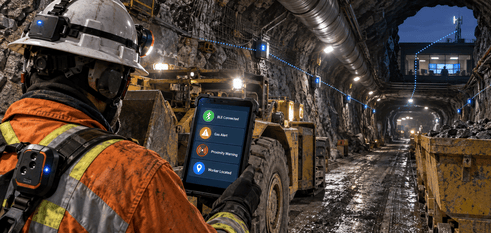
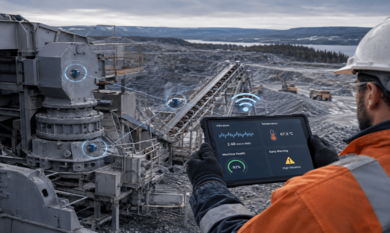
Each worker can wear a tag, often built into a cap lamp or helmet, while machines and fixed hazard zones carry their own units. Together, these BLE beacons and tags do the sensing. Because the signal is radio based, it does not need light or a clear view to work. That is exactly why it holds up in dust, darkness, and around blind corners where cameras struggle.
Gateways and the Signals That Trigger Alerts
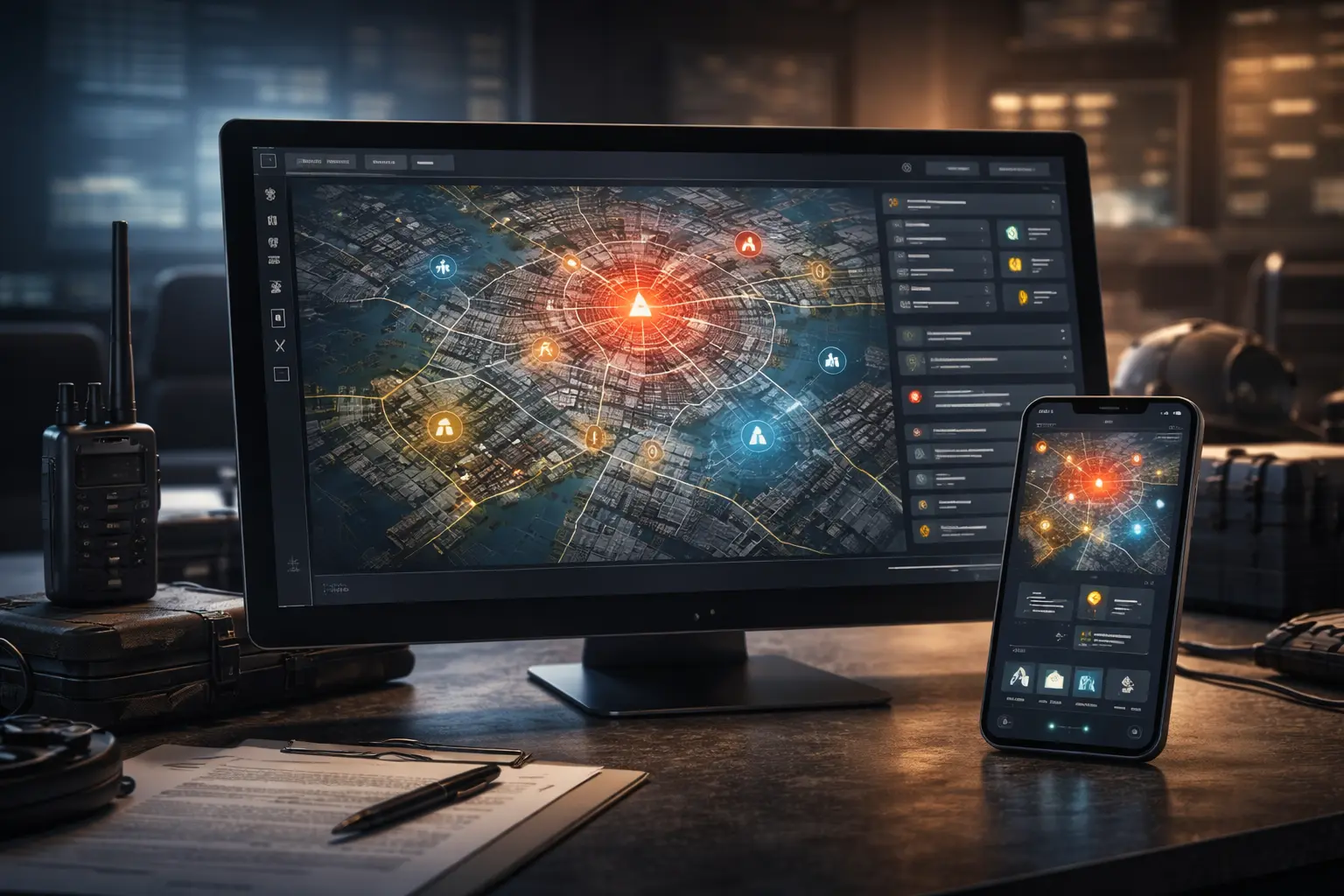
Gateways placed along the tunnels gather data from these devices and can pass it toward a control room. As a worker and a machine move closer, signal strength changes, and the system can trigger graduated warnings, a mild alert at a wider distance and a stronger audible and visual warning as the gap narrows. That gives both the worker on foot and the operator in the cab a moment to stop and check before moving on.
Where BLE Fits and Where It Needs Support
BLE has clear strengths for underground safety. It suits proximity awareness, the marking and monitoring of restricted zones, and keeping track of where people are across an operation. It is cost effective, it works without line of sight, and it can be scaled across a mine without the heavy cabling that some other systems require.
It is fair to be equally clear about its limits. For applications that call for very precise distance measurement, or for a collision avoidance system that automatically slows or stops a machine, BLE is often combined with other sensing technologies rather than used on its own. Different jobs and different machines call for different tools, and no single technology covers everything underground.
Whatever the setup, the point is to help the people doing the work, not to make decisions for them. A qualified operator or supervisor stays the decision maker. The technology adds awareness and time, and the person still makes the call.
How to Reduce Collisions Without Slowing Production
A common worry is that a safety system will stop production every time an alarm sounds. If a machine halts at each alert, crews can lose trust in the system and may look for ways around it, which defeats the purpose. The goal is to reduce equipment collisions in underground mines while keeping the production cycle moving.
Graduated alerts help here. Rather than a single hard stop, the system can give an early, low level warning when a worker and a machine are simply near each other, and reserve stronger responses for when the gap closes to a real risk. Zoning can also keep people and machines apart during routine hauling and dumping without interrupting every pass. Set up with care, proximity monitoring can improve awareness and encourage safer habits without fighting the pace of the work, so safety and production pull together instead of against each other.
Meeting Canadian Mine Safety Expectations
Canada's underground sector is largely hard rock and metal mining, and mine safety here is handled through provincial regimes rather than a single national rule. That means expectations can vary by province, and each operation needs to understand the obligations that apply where it works.
Across the industry, the interaction between people on foot and mobile equipment is treated as a serious risk. Canadian mine safety bodies have pointed to pedestrian exposure to mobile equipment, blind spots, and line of sight as priority concerns for underground operations, and have encouraged better equipment design and awareness tools as part of the response, as set out by Workplace Safety North. Investing in Canadian mine safety technology such as proximity monitoring can support this wider effort.
Responsibility for meeting the rules sits with the operator. Proximity monitoring can be a useful part of a safety program, but it does not remove the duty to assess risks, train workers, and comply with the requirements that apply to a given site.
Connecting Proximity Monitoring to Your Existing Systems
Proximity monitoring is far more useful when its data does not stay locked in one place. The same devices that warn workers can provide real-time worker location that feeds existing fleet, dispatch, or monitoring platforms, giving supervisors a clearer picture of where people and machines are across a shift.
Bringing these pieces together usually calls for a software layer that links tags, gateways, alerts, and reporting into the tools a mine already uses. This is where thoughtful BLE application development matters, so the system fits the operation rather than forcing new workflows onto crews. Teams delivering IoT and BLE development in Calgary can help plan a rollout around the equipment, layout, and systems a mine already runs, which usually makes it easier for crews to accept and more useful once it is live.
Frequently Asked Questions
Is BLE accurate enough for proximity detection underground?
For zone level awareness, BLE can be effective at the practical short ranges that matter most around machines. Where an operation needs very precise distance measurement, BLE is often paired with other technologies to sharpen accuracy.
Can BLE proximity monitoring automatically stop mining equipment?
On its own, BLE is generally used for awareness and alerts. Automatic slow or stop functions usually rely on additional sensing, and even then a qualified operator stays responsible for the final response.
Does BLE proximity monitoring work where there is no GPS underground?
Yes. BLE does not depend on satellite signal or line of sight, so it can operate in tunnels where positioning tools from the surface do not reach.
How is BLE different from RFID or UWB for worker tracking?
Each has trade offs. RFID is simple and low cost, ultra wideband can offer high precision, and BLE sits between them with useful range at a reasonable cost. The right choice depends on the task and the environment.
Who is responsible for mine safety compliance in Canada?
The operator holds that responsibility, guided by the provincial rules that apply to the site. Technology can support compliance, but it does not transfer the duty.
Building Safer Underground Operations in Calgary and Beyond
Underground mining will always place people close to powerful machines in difficult conditions. BLE proximity monitoring cannot change that, but it can add a useful layer of awareness that supports underground mine worker safety, encourages safer habits, and can give people extra moments to react. It works best when it is scoped with a clear view of its strengths, paired with other tools where needed, and connected to the systems a mine already relies on.
If you are exploring how proximity monitoring could fit your operation, the team at Theta Technolabs can help. Reach us at sales@thetatechnolabs.com to talk through a practical, well scoped approach.