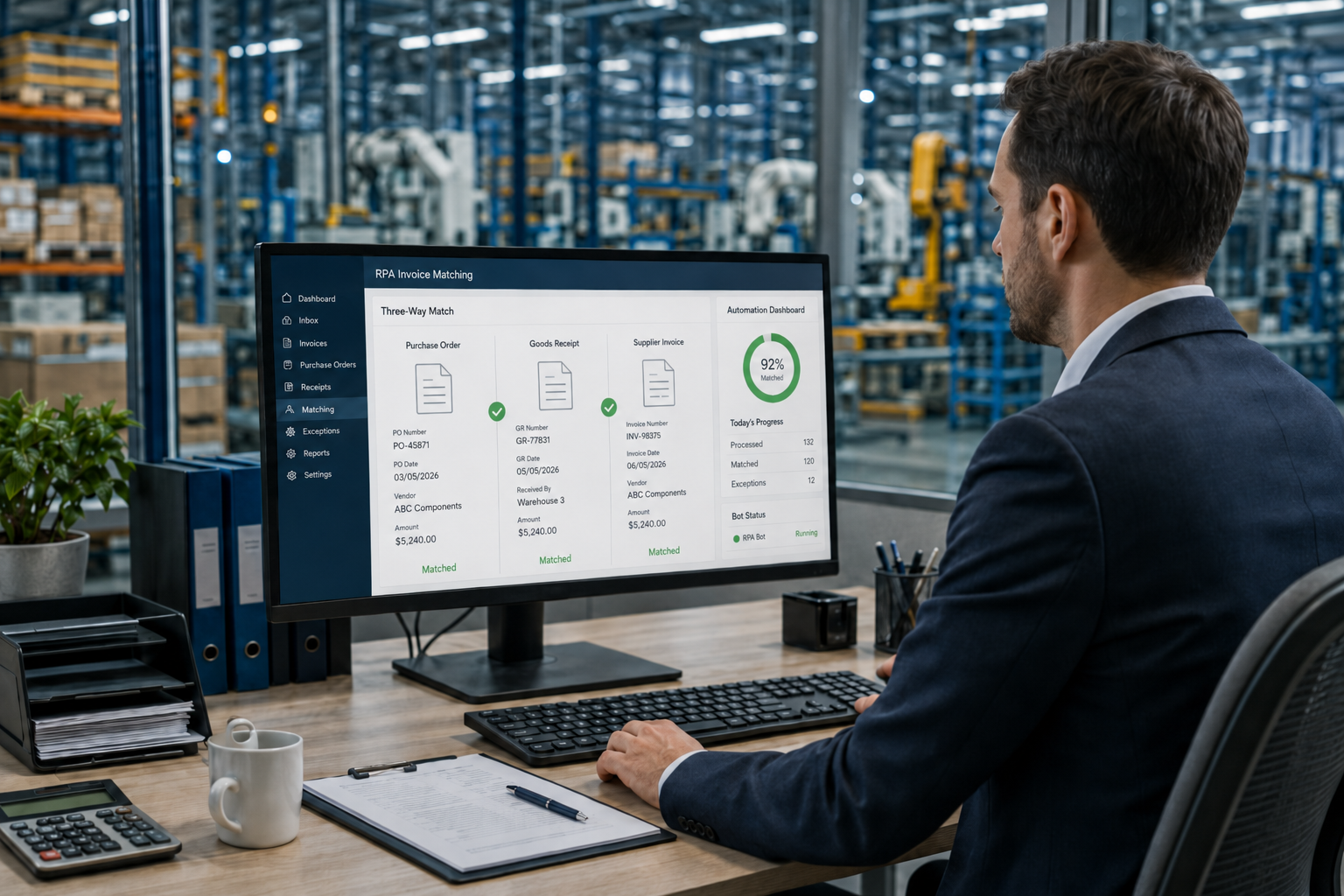


RPA bots for supplier invoice matching are becoming important for manufacturing companies that want to reduce manual accounts payable work, improve invoice accuracy, and create a more controlled supplier payment process. In manufacturing, invoice matching is not only about checking an invoice amount. It often involves purchase orders, goods receipts, delivery records, tax values, freight charges, and approval rules across different departments.
For Canadian manufacturers, this process can become more complex when supplier networks are large, invoices come in different formats, and ERP systems depend on accurate data. This is where RPA in accounts payable can help. With the right automation design, bots can collect invoices, extract key data, compare records, flag mismatches, route approvals, and update ERP systems with less manual effort.
This blog explains how RPA bots support accounts payable automation in manufacturing and why custom RPA workflows are useful for supplier invoice matching.
What Is Supplier Invoice Matching in Manufacturing?
Supplier invoice matching is the process of checking whether a supplier invoice matches the company’s purchasing and receiving records before payment is approved. In manufacturing companies, this usually means comparing the invoice with the purchase order, goods receipt, delivery notes, item quantities, unit prices, tax details, and approval status.
The goal is simple. The company wants to confirm that it is paying the right supplier, for the right items, at the agreed price, and only after the goods or services are received.
There are different types of matching used in manufacturing finance workflows.
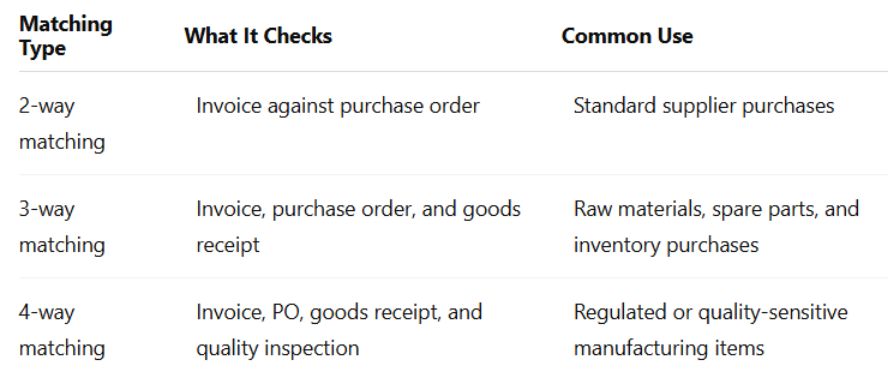
3-way invoice matching automation is especially useful in manufacturing because many invoices are linked to physical goods. AP teams must know whether goods were actually received before the supplier is paid.
Why Manual Supplier Invoice Matching Becomes Difficult for Manufacturers
Manual invoice matching may work when invoice volume is low. However, manufacturing companies often deal with frequent supplier invoices for raw materials, machine parts, packaging, maintenance supplies, logistics, and plant operations. As the business grows, manual matching becomes slower and more error-prone.
Common challenges include:
- High invoice volume from multiple suppliers
- Multi-line purchase orders with many item codes
- Partial shipments and delayed goods receipts
- Price differences between invoice and purchase order
- Quantity mismatch between invoice and received goods
- Freight, packaging, or handling charge variations
- Missing PO numbers on supplier invoices
- Duplicate invoice submission
- Manual ERP data entry
- Slow approval routing between finance, procurement, and plant teams
These issues can delay supplier payments and create extra work for AP teams. They can also affect month-end closing, cash flow visibility, and supplier relationships.
Manufacturers that are already investing in manufacturing software solutions can also improve finance operations by automating repetitive invoice validation and approval steps. This makes invoice matching automation for manufacturing more than a back-office upgrade. It becomes part of a broader digital workflow improvement strategy.
How RPA Bots Automate Supplier Invoice Matching Step by Step
RPA bots automate repetitive, rule-based tasks by interacting with applications in a structured way. In supplier invoice automation, bots can support the AP team from invoice collection to ERP posting. However, the workflow must be designed carefully because not every invoice should be approved automatically.
1. Invoice Collection from Emails, Portals, and Shared Folders
The bot can monitor supplier email inboxes, vendor portals, shared folders, or document management systems. When a new invoice arrives, the bot downloads or captures the file and organizes it for processing.
This helps AP teams avoid manually checking multiple sources throughout the day.
2. Invoice Data Extraction and Validation
After collecting the invoice, the bot extracts important fields such as:
- Supplier name
- Invoice number
- Invoice date
- PO number
- Item code
- Quantity
- Unit price
- Tax value
- Freight charges
- Total amount
For PDF or scanned invoices, OCR or intelligent document processing may be used along with RPA. The bot can then validate the extracted information against supplier master data and purchasing records.
3. Matching with Purchase Orders and Goods Receipts
Once the invoice data is extracted, the bot compares it with purchase order and goods receipt records. This is where purchase order invoice matching becomes important.
For example, if the PO says 1,000 units were ordered at a specific price, but the invoice shows a higher price or different quantity, the bot can flag the mismatch. In 3-way invoice matching automation, the bot also checks whether the goods receipt confirms that the items were actually received.
4. Exception Detection and Approval Routing
RPA bots should not blindly approve invoices. If the invoice does not match the PO, goods receipt, tax value, or supplier record, the bot should mark it as an exception.
Automated invoice exception handling may include routing the invoice to:
- AP team for invoice review
- Procurement team for price or PO issues
- Plant team for receiving confirmation
- Quality team for inspection-related holds
- Finance manager for approval based on value thresholds
This keeps humans in control where judgment is required.
5. ERP Posting and Audit Logs
After successful validation and approval, the bot can update the ERP or accounting system. This may include posting invoice details, changing invoice status, attaching supporting documents, and sending reports to the AP team.
For manufacturers using ERP or accounting platforms, RPA Implementation & Integration Services in Canada can help connect invoice bots with purchase order, goods receipt, approval, and finance systems.
ERP invoice processing automation also improves visibility because teams can track what was matched, what was flagged, who approved it, and when the invoice was posted.
Common Invoice Exceptions RPA Bots Can Detect
One of the most valuable parts of RPA bots for supplier invoice matching is exception detection. In manufacturing, many invoice issues are not simple data entry errors. They may come from delivery differences, supplier terms, freight charges, or internal approval delays.
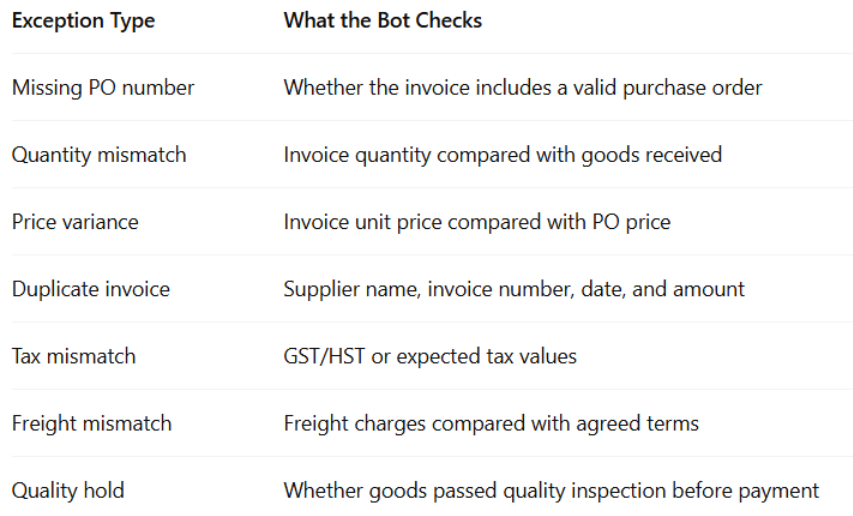
This kind of automated invoice exception handling helps AP teams focus on invoices that need attention instead of reviewing every invoice manually.
Real-World Example: RPA in Manufacturing Accounts Payable
A relevant example comes from Cognizant’s manufacturing accounts payable RPA case study. Cognizant reported that a large multinational manufacturing conglomerate was processing about 80,000 supplier invoices per year and needed to improve the speed, accuracy, and compliance of its supplier payment process. The RPA solution helped automate invoice preparation tasks, validate supplier details, process invoice data, and generate exceptions for cases such as missing purchase orders or non-standard invoice formats.
This example is useful because it shows how RPA in accounts payable can support real manufacturing finance workflows. It also highlights an important point: RPA is most effective when it is designed around actual business rules, supplier data, ERP records, and exception conditions.
Canadian manufacturers can apply a similar principle. The exact outcome will depend on invoice volume, system readiness, data quality, and implementation design.
Business Benefits for Canadian Manufacturing Companies
RPA automation services in Canada can help manufacturers improve supplier invoice matching without replacing their entire ERP or finance system. The main value comes from reducing repetitive tasks, improving process visibility, and helping AP teams manage exceptions more efficiently.
Key benefits include:
- Reduced manual AP workload
- Faster invoice validation
- Better supplier payment accuracy
- Lower duplicate invoice risk
- Improved visibility into invoice status
- Stronger audit trail
- Better coordination between AP, procurement, and plant teams
- More scalable invoice handling during high-volume periods
- Faster follow-up on exceptions and missing information
Invoice matching automation for manufacturing can also support better supplier relationships. When invoices are validated faster and exceptions are identified earlier, suppliers receive clearer communication about payment status or required corrections.
However, it is important to stay realistic. RPA does not automatically fix poor data quality, unclear approval rules, or incomplete ERP records. The best results come when manufacturers first review their current AP workflow and then design supplier invoice automation around the real process.
What to Consider Before Implementing RPA Bots for Invoice Matching
Before implementing RPA bots, manufacturers should review their invoice process carefully. A bot can follow rules, but the rules must be clear, stable, and connected to reliable data.
Important points to check include:
- Monthly supplier invoice volume
- Common invoice formats
- ERP or accounting system readiness
- Supplier master data quality
- Purchase order accuracy
- Goods receipt update process
- Approval hierarchy
- Exception handling rules
- Tax and freight validation requirements
- User access and security permissions
- Reporting and audit trail needs
- Bot monitoring and maintenance plan
ERP invoice processing automation works better when finance, procurement, IT, and plant teams are aligned. For example, if goods receipt data is not updated on time, the bot may flag many invoices as exceptions even when the delivery happened correctly. That is why process mapping is just as important as bot development.
How RPA Automation Design & Bot Development Services in Canada Help
Every manufacturing company has its own supplier process, ERP setup, approval structure, and exception rules. A ready-made workflow may not fully match these operational needs. This is where custom RPA design becomes useful.
With tailored RPA Automation Design & Bot Development Services in Canada, manufacturers can build invoice bots around their existing ERP, AP approval workflows, supplier formats, and exception rules.
A reliable RPA partner can help with:
- AP process assessment
- Bot workflow design
- Invoice data extraction logic
- PO and goods receipt matching rules
- ERP integration planning
- Exception routing setup
- Testing and validation
- Bot monitoring and support
This approach helps manufacturers automate the right parts of the invoice process while keeping human review in place for exceptions, approvals, and financial control.
Conclusion
Supplier invoice matching is a critical process for manufacturing companies because it directly affects payment accuracy, supplier relationships, AP workload, and financial control. RPA bots can help by collecting invoices, extracting data, matching invoices with purchase orders and goods receipts, detecting exceptions, routing approvals, and updating ERP systems.
For Canadian manufacturers, the value of RPA depends on proper workflow design, clean data, clear approval rules, and the right implementation approach. Theta Technolabs supports businesses with Web, Mobile, and Cloud capabilities along with RPA Automation Design & Bot Development Services in Canada to help improve finance and operational workflows.
Automate Supplier Invoice Matching with Custom RPA Bots
Want to reduce manual invoice matching and improve accounts payable efficiency in your manufacturing business?
Theta Technolabs can help Canadian manufacturers design RPA bots for supplier invoice matching, ERP integration, workflow automation, and invoice exception handling. Our team can assess your current AP process and build automation around your real business rules.
To discuss your RPA automation needs, contact us at sales@thetatechnolabs.com.
FAQs
1. How do RPA bots match supplier invoices with purchase orders?
RPA bots extract invoice details such as supplier name, PO number, invoice number, quantity, price, tax, and total amount. They then compare these details with purchase order records in the ERP or accounting system. This supports faster purchase order invoice matching and reduces manual checking.
2. Can RPA bots perform 3-way invoice matching?
Yes, RPA bots can support 3-way invoice matching automation if invoice, purchase order, and goods receipt data are available. The bot compares all three records and flags mismatches for review before payment approval.
3. What happens when an invoice does not match the PO or goods receipt?
When an invoice does not match, the bot should mark it as an exception. It can route the invoice to AP, procurement, plant operations, or finance managers depending on the issue. The invoice should not be automatically approved until the mismatch is reviewed.
4. Do RPA bots work with ERP systems used by manufacturers?
Yes, RPA bots can work with ERP systems when access, fields, workflows, and validation rules are properly configured. They can read PO records, check goods receipts, update invoice status, and support ERP invoice processing automation.
5. Is RPA invoice matching useful for Canadian manufacturing companies?
Yes, RPA can be useful for Canadian manufacturers that handle high supplier invoice volume, multi-location approvals, repetitive AP tasks, and ERP-based purchase workflows. The value depends on invoice complexity, process maturity, data quality, and implementation design.